The GST registration threshold in Australia is $75,000 in annual turnover. Once your tradie business earns $75,000 or more in a 12-month period, you must register for GST with the ATO — no exceptions. Fall below that and registration is optional. This guide explains how to calculate your turnover, what the threshold actually means, and what changes once you're registered.
Disclaimer: TradesBill is not a registered tax agent or BAS agent. The information in this article is general in nature. For advice specific to your situation, speak to a registered tax agent or BAS agent.
What is the GST registration threshold in Australia?
The ATO sets the GST registration threshold at $75,000 of annual GST turnover for most businesses, including sole-trader tradies. If your business earns less than $75,000 per year, you can choose to register for GST — but you don't have to.
There are two exceptions worth knowing:
- Taxi and ride-share drivers must register for GST from their very first dollar of income — no threshold applies.
- Not-for-profit organisations have a higher threshold of $150,000 (not relevant for most tradies).
How to calculate your annual GST turnover
Your annual GST turnover is the total value of all your business sales over a 12-month period, measured excluding GST. It includes:
- All invoices you issue for labour and materials
- Cash jobs (even if you don't invoice them)
- Any other income from your tradie business
Private income — like a salary from a part-time job — does not count toward your GST turnover. Only your business income counts.
The ATO looks at your current annual turnover (the past 12 months) and your projected annual turnover (the next 12 months). If either figure is $75,000 or more, you need to register.
Example: A plumber earns $6,800/month on average. That's $81,600 per year — above the $75,000 threshold. She needs to register for GST.
A part-time handyman earns $3,200/month — $38,400 per year. He doesn't have to register, but he can choose to if it suits his business.
When do you need to register after crossing the GST registration threshold?
Once you know (or expect) your turnover will reach $75,000, the ATO requires you to register for GST within 21 days. Don't wait until the end of the financial year — the obligation kicks in as soon as you cross the threshold.
You can register through:
- The ATO's Business Portal online
- Your registered tax agent or BAS agent
- By calling the ATO on 13 28 66
Should you register for GST voluntarily?
Even if you're under the GST registration threshold, there are reasons to register voluntarily:
- You can claim GST credits on your business purchases. If you spend a lot on tools, materials, or vehicles, the GST you paid on those comes back to you through your BAS.
- It looks more professional. Larger builders and commercial clients often expect their subcontractors to be GST-registered.
- You're approaching the threshold. If you're at $65,000–$74,000, registering now avoids a scramble later.
The downside of voluntary registration is that you must now charge GST to your customers and lodge BAS statements every quarter (or month). For a tradie doing small residential jobs for price-sensitive customers, that 10% markup can be a competitive disadvantage.
What changes when you register for GST?
Once registered, three things change for every invoice you send:
- You must charge GST (10%) on your taxable supplies. Most tradie labour and materials are taxable supplies.
- Your invoices must become Tax Invoices — including the words "Tax Invoice", your ABN, and a separate GST amount. See what a Tax Invoice must include for the full ATO checklist.
- You must lodge a BAS (Business Activity Statement) quarterly or monthly, reporting GST collected and GST credits claimed.
How does GST work on a tradie invoice?
As a GST-registered tradie, you add 10% GST to your prices. The GST is collected on behalf of the ATO — it's not your money to keep. At BAS time, you pay the collected GST to the ATO, minus any GST credits you've earned on your own business purchases.
For example: an electrician charges $1,000 for a job (ex-GST). He adds 10% GST — the customer pays $1,100 total. The $100 GST goes to the ATO. But if the electrician bought $220 of materials (including $20 GST), he claims that $20 back as a credit, so his net GST payment is $80.
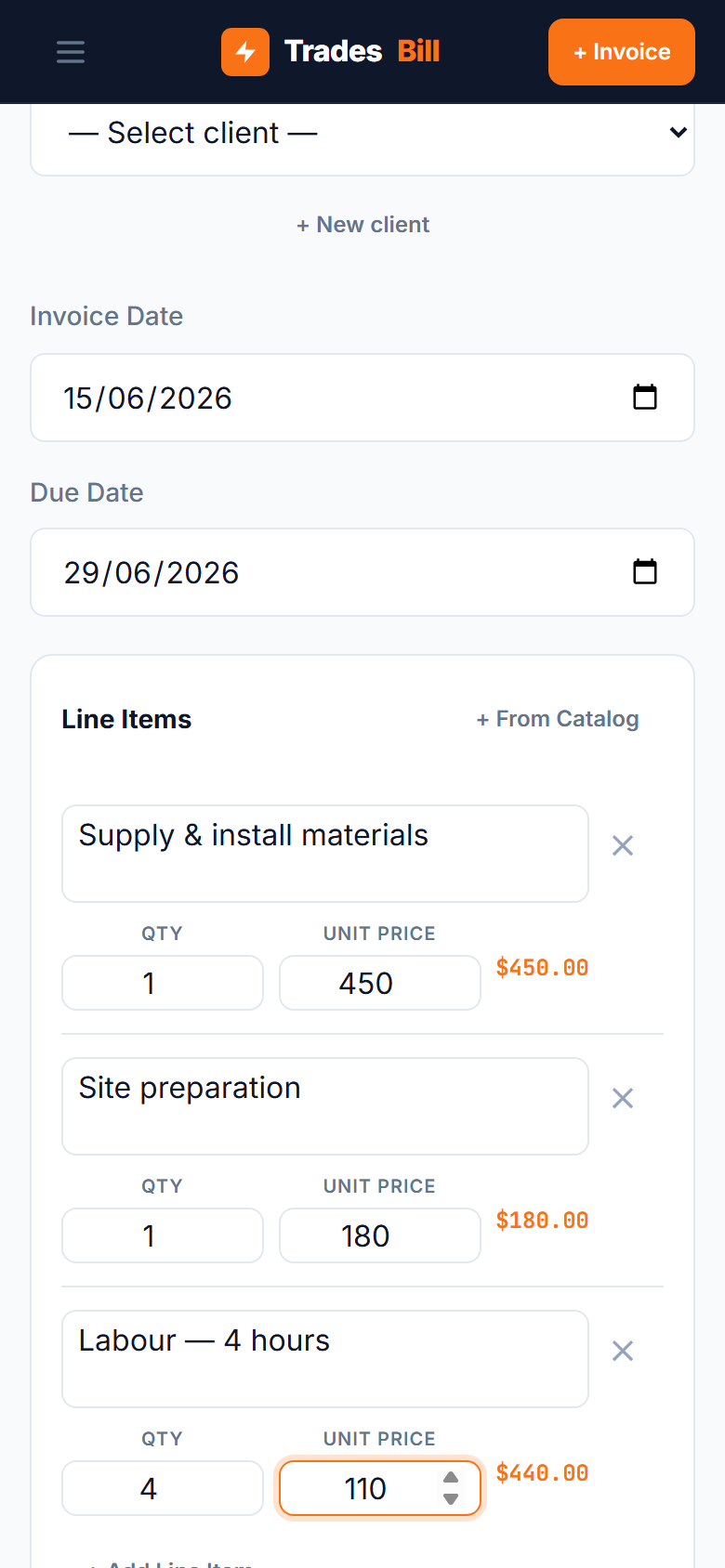
A free invoice app for tradies like TradesBill handles all this automatically — you enter your prices, it calculates the GST and invoice total in real time. See our guide on how to calculate GST on an invoice for the full formula.
| Scenario | Register for GST? |
|---|---|
| Annual turnover ≥ $75,000 | Must register |
| Annual turnover < $75,000 | Optional |
| Taxi / ride-share driver | Must register (any amount) |
| Not-for-profit organisation | Must register ≥ $150,000 |
Frequently asked questions about the GST registration threshold
What happens if I don't register when I should?
If you pass the $75,000 threshold and don't register within 21 days, the ATO can backdate your registration and make you liable for GST you should have collected — even if you didn't charge it to your customers. That GST comes out of your pocket. It's not worth the risk.
Does the $75,000 threshold reset each financial year?
The ATO looks at any rolling 12-month period — not just the financial year. If you cross $75,000 in, say, February to January, you need to register immediately, not wait until 1 July.
Can I deregister for GST if my turnover drops below $75,000?
Yes. If your turnover falls (and you expect it to stay) below $75,000, you can apply to cancel your GST registration. However, if you voluntarily registered, you must wait at least 12 months before cancelling. Speak to a registered BAS agent before deregistering.
Do I include GST-free sales in my turnover calculation?
Yes. Your GST turnover includes the value of all sales — taxable supplies, GST-free supplies (like some food and exported goods), and input-taxed supplies. Most tradie work is fully taxable, so this distinction rarely matters in practice.
What if I'm a subcontractor working for a builder?
Each business is assessed independently. Your $75,000 threshold is based on your own turnover, not your principal contractor's. If you earn $75,000 or more from subcontracting work, you must register regardless of whether the builder is GST-registered.
Invoice correctly from day one
TradesBill automatically generates ATO-compliant Tax Invoices with your ABN, GST breakdown, and "Tax Invoice" label — everything you need once you're GST-registered. Free forever.
Create your first Tax Invoice — Free