One of the most common questions Australian tradies ask is: what's the difference between a quote and an invoice? Both documents list your services and prices — but they serve completely different purposes, and sending the wrong one at the wrong time can cause confusion, disputes, and payment delays. This guide explains the difference between a quote and an invoice in Australia, when to use each, and how to move from one to the other without the paperwork headache.
What is a quote?
A quote is a document you send to a potential customer before any work begins. It sets out what you'll do, how much it will cost, and any conditions that apply. In Australia, a quote is generally considered a binding offer — if the customer accepts it, you're both locked into those terms.
Key things a quote is not:
- It's not a request for payment
- It's not a tax invoice (even if it includes GST amounts)
- It's not proof that work has been completed
Quote vs estimate: An estimate is a rough guide to cost — not binding. A quote is a fixed price offer. Always be clear with your customer which one you're providing. If you write "Quote" at the top of the document, they can hold you to that price.
What is an invoice?
An invoice is a request for payment, sent after the work is done (or at an agreed milestone for larger jobs). It tells the customer exactly what they owe and when payment is due.
If you're registered for GST, your invoice must also be a Tax Invoice — a specific document that meets ATO requirements and allows your customer to claim their GST input tax credits. Read our guide on what a tax invoice must include for the full ATO checklist.
The key differences between a quote and an invoice in Australia
| Quote | Invoice | |
|---|---|---|
| When to send | Before work starts | After work is done (or at agreed milestone) |
| Purpose | Propose a price and scope of work | Request payment for completed work |
| Payment required? | No — it's an offer, not a bill | Yes — customer owes this amount |
| Legal status | Binding offer once accepted | Demand for payment; legally enforceable |
| ATO / GST label | Label as "Quote" — not a Tax Invoice | Must be labelled "Tax Invoice" if GST-registered |
| GST claimable? | No — customers can't claim GST from a quote | Yes — if it's a valid ATO Tax Invoice |
| Expiry | Usually 30 days (include on the quote) | Payment due date (e.g. 7 or 14 days) |
When to send a quote vs when to send an invoice
The workflow for most tradie jobs looks like this:
- Customer enquires about a job — they want to know what it'll cost.
- You send a quote — outlining the scope, price (ex-GST and inc-GST), and expiry date.
- Customer accepts the quote — verbal or in writing. You're both committed.
- You complete the work — or reach a payment milestone (e.g. 50% completion on a large job).
- You send a Tax Invoice — listing what was done, the amount owed, and your payment details.
- Customer pays — and you mark the invoice as paid.
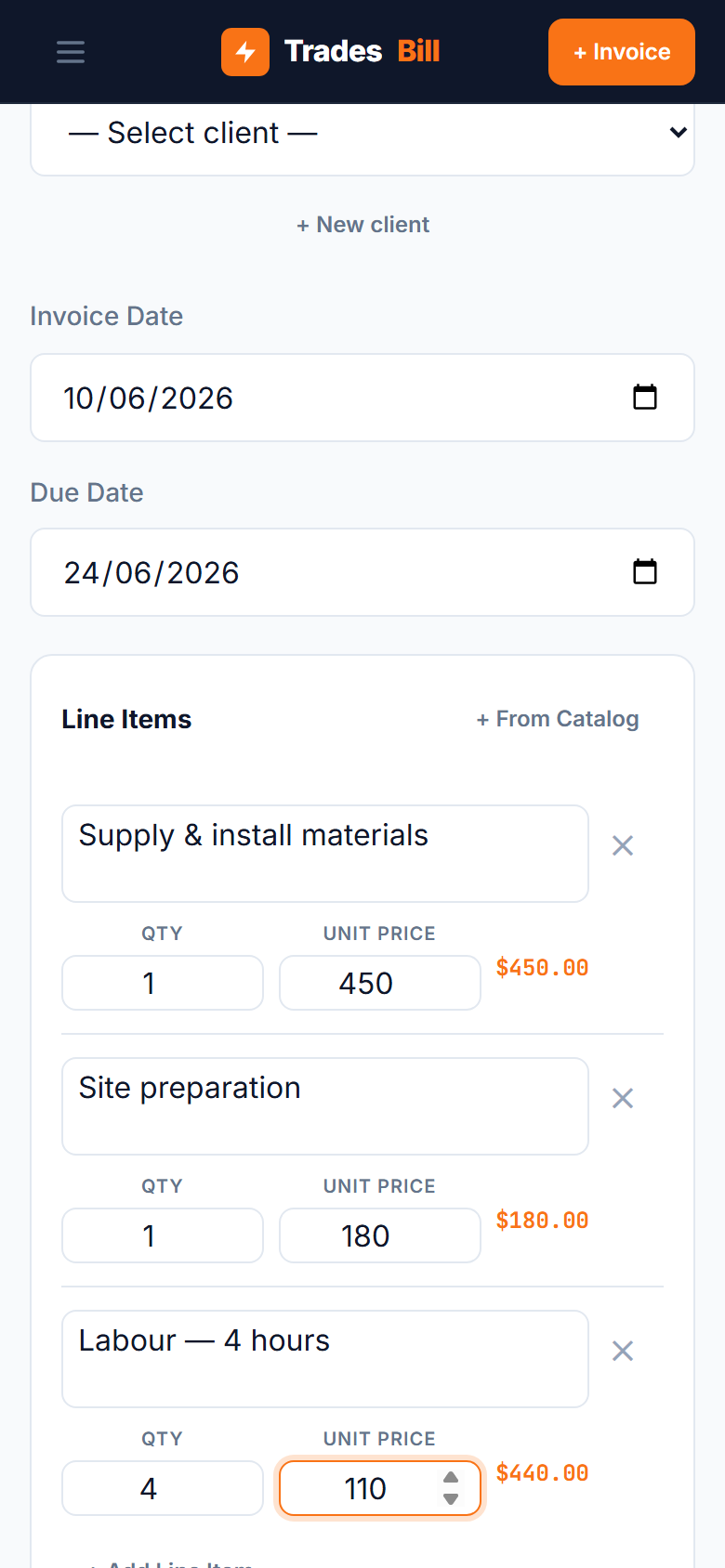
The quote never becomes the invoice — you need to issue a separate invoice once the work is done. Some free invoice apps for tradies let you convert a quote to an invoice with one tap, automatically carrying over all the line items so you don't have to re-enter everything.
Can you charge more than the quoted price?
In Australia, if you've issued a fixed-price quote and the customer has accepted it, you generally can't charge more — even if the job turns out to be bigger than expected. This is a common headache for tradies who quote jobs sight-unseen.
To protect yourself:
- Include a note on your quote that it's based on stated conditions and variations will be charged at your standard rate
- Issue a variation invoice for any additional work the customer approves after the original quote
- For complex jobs, use an estimate instead of a fixed-price quote until you've assessed the full scope
Variation tip: Always get approval for variations in writing — a text message reply is fine — before doing additional work. Without customer approval, collecting payment for out-of-scope work becomes much harder.
Progressive invoicing for larger jobs
On large jobs (renovations, commercial fit-outs, multi-week projects), it's common to invoice in stages rather than waiting until the end. Typical arrangements include:
- Deposit invoice — 10–30% upfront before work begins
- Progress invoice — 40–50% at an agreed milestone (e.g. frame up, rough-in complete)
- Final invoice — remaining balance on practical completion
Each progress invoice should reference the original quote so the customer can see what stage they're paying for. If you want a deeper walkthrough of how this all fits together, read our guide on the complete quote-to-paid workflow for tradies.
GST on quotes vs invoices
If you're registered for GST, both your quote and your invoice should show GST — but only the invoice is the document your customer uses to claim their GST back from the ATO.
Your quote should clearly show the GST-inclusive price so the customer knows exactly what they'll pay. But it must be labelled "Quote", not "Tax Invoice". Labelling a quote as a "Tax Invoice" before any payment is due could confuse the customer and create compliance issues.
When you issue the Tax Invoice after the work is done, the GST amount needs to be shown separately — not just included in the total. See our guide on how to calculate GST on an invoice for the exact formulas.
Quotes and invoices, done — in seconds
TradesBill lets you create professional quotes, get customer acceptance, and convert to a compliant Tax Invoice with one tap — all for free. Works offline, no account required.
Try TradesBill FreeFrequently asked questions
Is a quote legally binding in Australia?
Yes. Once a customer accepts a fixed-price quote, it forms a binding contract. You must do the work at the quoted price, and they must pay it. Verbal acceptance counts — but written acceptance is much easier to prove if there's a dispute.
Can a quote be used as a tax invoice?
No. A quote is not a tax invoice — it's an offer to do work at a set price. Your customer cannot use a quote to claim GST input tax credits. Only a properly labelled Tax Invoice (issued after the work is done or at an agreed payment milestone) lets them claim GST back from the ATO.
How long should a quote be valid for?
Typically 30 days. Material and labour costs change, so you don't want to be locked into a price you quoted six months ago. Always include an expiry date on your quote — something like "This quote is valid for 30 days from the date issued."
What's the difference between a quote and an estimate?
An estimate is a non-binding rough guide — the final price can change. A quote is a fixed price offer that becomes binding when the customer accepts. Always be clear which one you're providing. If in doubt, use the word "Estimate" and explain to your customer that the final price may vary.
Do I need to issue a separate invoice if I already sent a quote?
Yes. A quote and an invoice are separate documents. Once the work is done, you need to issue a Tax Invoice (if you're GST-registered) to request payment. The invoice can reference the original quote number so the customer can see the connection.