Chasing an unpaid invoice is one of the least enjoyable parts of running a trade business — but it's also one of the most important. The longer an invoice sits unpaid, the less likely you are to ever see the money. Most late payments aren't malicious; they're forgotten, buried in someone's inbox, or waiting on the client's own cash flow. A clear, professional follow-up process fixes most of these cases without damaging the relationship.
This guide gives you a proven follow-up timeline and ready-to-use email templates you can copy for every stage — from a friendly nudge on day one to a final notice before you consider further action.
When to follow up on an unpaid invoice
Your payment terms set the clock. If your invoice says "due within 7 days," don't wait a month to say something. A consistent follow-up timeline keeps cash flowing and signals to clients that you take payment seriously:
- Due date reached (Day 0): Send a friendly reminder if payment hasn't landed — a gentle nudge, not an accusation.
- 7 days overdue: Send a firmer follow-up referencing the original invoice and due date.
- 14 days overdue: Call the client directly, then follow up the call with a written summary by email.
- 30 days overdue: Send a final notice outlining next steps, including any late payment fee that applies.
- 30+ days overdue: Consider whether to pause further work for that client, engage a debt collector, or lodge a claim through your state's small claims tribunal.
Tip: Send the very first reminder on the due date itself, even if it's just a light-touch email. Clients who intend to pay usually respond quickly to an early nudge, and it establishes that you track your invoices closely.
Before you chase — make sure the invoice itself is solid
A surprising number of "late" payments are actually disputes waiting to happen — the invoice was unclear, sent to the wrong contact, or missing details the client's accounts team needs to process it. Before sending a follow-up, check that your original invoice:
- Is a valid Tax Invoice with all ATO-required fields
- Clearly states the due date and payment terms
- Includes your bank details or payment link
- Shows the GST amount separately from the subtotal
- Was sent to the right person — not just "the office" or a general inbox that nobody checks
If any of these are missing, fix and resend the invoice first — it may explain the delay, and a client can't be expected to pay an invoice they never properly received.
Email template 1: Friendly reminder (due date / just overdue)
Keep the first reminder short, warm, and low-pressure. Most late payments are simple oversights.
Subject: Reminder — Invoice #[number] due today
Hi [Client name],
Just a quick reminder that invoice #[number] for $[amount] was due for payment today. I've attached a copy in case it's easier to find.
If you've already sent payment, no need to reply — thanks! If not, you can pay via [bank transfer / payment link] using the details on the invoice.
Let me know if you have any questions.
Thanks,
[Your name]
[Business name]
Email template 2: Firm follow-up (7-14 days overdue)
Still friendly, but more direct — reference the original due date and ask for a specific response.
Subject: Invoice #[number] — now [X] days overdue
Hi [Client name],
I'm following up on invoice #[number] for $[amount], which was due on [due date] and is now [X] days overdue.
Could you please arrange payment as soon as possible, or let me know if there's an issue I should be aware of? I've attached the invoice again for your records.
Payment can be made via [bank transfer / payment link] using the details on the invoice.
Please confirm once payment has been made, or get in touch if you'd like to discuss.
Regards,
[Your name]
[Business name]
Email template 3: Final notice (30+ days overdue)
By this stage, be clear about the consequences of continued non-payment while remaining professional. If you charge a late payment fee, this is where you reference it.
Subject: Final notice — Invoice #[number] — [X] days overdue
Hi [Client name],
This is a final notice regarding invoice #[number] for $[amount], due on [due date] and now [X] days overdue. Despite previous reminders sent on [date] and [date], payment has not been received.
Please arrange payment in full within the next 7 days. [If applicable: A late payment fee of $[amount]/[X]% has now been applied in accordance with the payment terms stated on your invoice.]
If payment is not received by [date], I will need to consider further steps to recover this debt, which may include referring the matter to a debt collection agency or lodging a claim through the relevant tribunal.
I'd much prefer to resolve this directly — please contact me if you're experiencing difficulty so we can discuss a payment plan.
Regards,
[Your name]
[Business name]
What to do if emails aren't working
- Call the client directly. A phone conversation often resolves what email can't — you can hear whether it's a genuine dispute, a cash flow issue, or simple forgetfulness, then follow up in writing to confirm what was agreed.
- Offer a payment plan. If the client is short on cash, splitting the balance into two or three payments can get you paid faster than waiting for a lump sum that may never come.
- Check your payment terms allow a late fee. You can only charge a late payment fee if your original invoice or contract clearly stated the fee and the conditions for applying it.
- Know your escalation options. For debts under your state's small claims threshold, tribunals like NSW's NCAT, VIC's VCAT, or QLD's QCAT offer a low-cost path to recover money without a lawyer. For larger or more complex debts, a solicitor's letter of demand or a debt collection agency may be the next step.
- Pause further work. If a client is chronically late and unresponsive, it's reasonable to hold off on starting new work until the outstanding balance is cleared.
How to prevent late payments in the first place
Chasing invoices is far easier when you build good habits into how you invoice:
- Invoice immediately — on the day the job finishes, not days or weeks later.
- Keep payment terms short — 7 days is far easier to track and enforce than 30.
- Make paying easy — include a direct bank transfer or payment link so there's no friction.
- Request deposits upfront for larger jobs so you're not carrying the full risk.
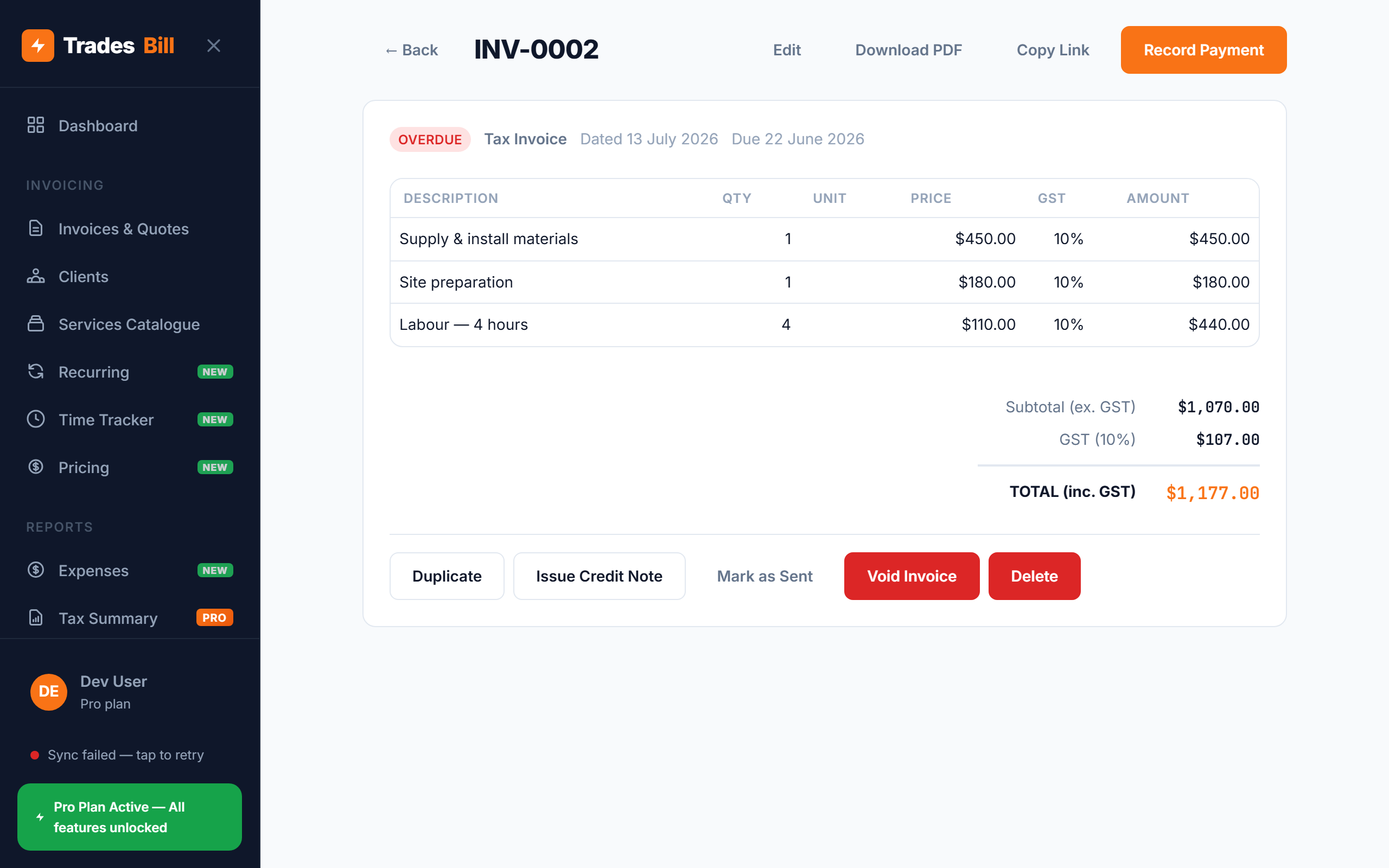
- Use an invoicing app that tracks status automatically — so overdue invoices are flagged the moment they cross the due date, instead of you having to remember to check.
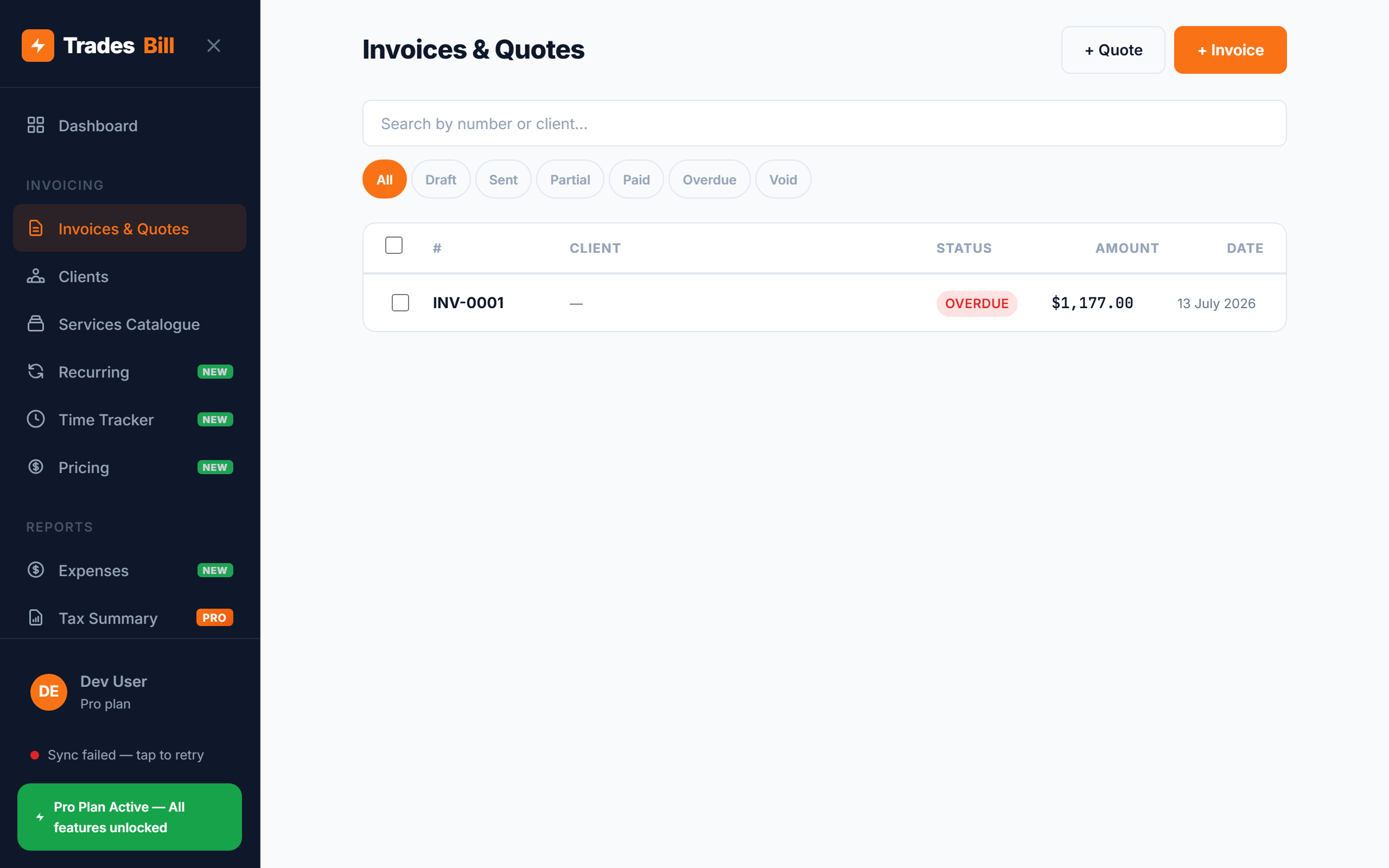
A good free invoice app for tradies flags overdue invoices automatically and makes it easy to see, at a glance, exactly who owes you money and for how long.
Never lose track of an unpaid invoice again
TradesBill automatically flags overdue invoices with clear status badges, so you always know who owes you money. Free forever, works offline.
Create your first invoice — FreeFrequently asked questions
How many times should I follow up before taking further action?
Three follow-ups is a reasonable standard: a friendly reminder at the due date, a firmer follow-up around 7-14 days overdue, and a final notice at 30 days. If there's still no payment or response after that, it's time to consider escalation.
Can I charge interest or a late fee on an overdue invoice?
Only if you clearly stated the fee or interest rate — and the conditions for applying it — on your original invoice or contract. You can't add a late fee retroactively if it wasn't agreed to upfront.
Should I stop work for a client who hasn't paid?
That's a business judgement call, but it's common and reasonable practice to pause new work for a client with an unpaid balance, particularly if they've been unresponsive to follow-ups.
What if the client disputes the invoice?
Address the dispute directly and promptly — ask exactly what they're disputing (the amount, the scope, the quality of work) and respond with evidence such as the signed quote, photos, or your job notes. Most disputes are resolved faster with a phone call than a chain of emails.
Is there a cheap way to recover a small unpaid debt without a lawyer?
Yes. Each state has a tribunal (such as NSW's NCAT, VIC's VCAT, or QLD's QCAT) that handles small claims — including unpaid invoices — without needing a solicitor. Check the threshold and process for your state before considering a debt collection agency or legal action.