Chasing unpaid invoices is frustrating enough without wondering whether you're even allowed to add a fee for the trouble. Plenty of Australian tradies charge a late payment fee — but only some of them are doing it correctly. Charge one without the right groundwork, and a client can refuse to pay it, or worse, dispute the whole invoice.
This guide covers exactly what you need in place before you can charge a late payment fee on an invoice, how much is reasonable, and wording you can copy straight onto your own invoices and quotes.
Can you legally charge a late payment fee in Australia?
Yes — but only if the client agreed to it upfront. There's no automatic right under Australian law to slap a late fee on an overdue invoice after the fact. The fee (or the interest rate, or both) needs to have been clearly disclosed in your payment terms before the work started — usually on your quote, contract, or the original invoice itself.
If your payment terms are silent on late fees and you try to add one after the due date has passed, the client is within their rights to refuse it. You can still chase the original invoice amount — you just can't add a penalty that was never agreed to.
Key rule: Disclose the fee before the debt exists, not after. "Late payment fees apply after 7 days" written on the invoice that becomes overdue works. Emailing "you now owe a $50 late fee" a month later, with no prior mention of one, does not.
Where to put your late payment fee terms
The safest approach is to state your terms in more than one place, so there's no argument the client wasn't aware:
- On your quote or contract — before the job even starts, so the client agrees to the terms as part of accepting the work.
- On every invoice — in the payment terms section, near the due date, so it's visible every time you bill.
- In a standard terms and conditions document — referenced on your invoice and provided to new clients, especially for larger commercial jobs.
Repeating the terms this way means you're covered whether the client only ever looked at the quote, or only ever looks at invoices.
How much can you charge for a late payment fee?
There's no single legislated cap that applies to every tradie-client invoice in Australia, but the fee needs to be reasonable — a genuine estimate of the cost of chasing late payment, not a way to profit off a slow-paying client. Excessive penalty fees can be challenged as an unenforceable "penalty clause" rather than a legitimate cost recovery.
Two common approaches:
- A flat late fee — a fixed dollar amount added once the invoice passes its due date, commonly somewhere between $20 and $50 for typical trade invoices. Keep it proportionate to the invoice size and the admin cost of chasing it.
- Interest on the overdue amount — a percentage per month or per annum applied to the unpaid balance until it's settled, commonly in the range of 1-2% per month (roughly 10-24% per annum). Some tradies reference the Reasonable Time for Payment guidelines or a rate tied to the RBA cash rate plus a margin, though there's no requirement to use either.
You can use one or the other, or both — for example, a flat $30 fee once an invoice is 7 days overdue, plus 1.5% monthly interest on any balance still outstanding after 30 days. Whatever you choose, write the exact figure or formula into your terms — vague wording like "a reasonable late fee may apply" is much weaker if a client pushes back.
Disclaimer: TradesBill is not a registered tax agent or law firm. This article is general information, not legal advice. If you're setting up late payment terms for a business with significant commercial invoice values, it's worth having a solicitor review your standard terms and conditions.
Late payment fee wording you can copy
Add wording like this to your quotes, contracts, and invoice payment terms:
Flat fee version:
"Payment is due within [7] days of the invoice date. A late payment fee of $[30] applies to any invoice not paid in full by the due date."
Interest version:
"Payment is due within [7] days of the invoice date. Overdue amounts accrue interest at [1.5%] per month, calculated daily, until paid in full."
Combined version:
"Payment is due within [7] days of the invoice date. A late payment fee of $[30] applies to invoices unpaid after the due date, plus interest of [1.5%] per month on any balance still outstanding after 30 days."
Fill in the brackets with your own numbers, and keep the wording consistent across your quotes and invoices so there's no ambiguity about which terms apply.
Does GST apply to a late payment fee?
Generally, no. A genuine late payment fee or interest charge is treated as compensation for late payment rather than payment for goods or services, so it typically isn't subject to GST. Show it as a separate line item rather than folding it into your GST-taxable line items. If you're unsure how to treat a specific fee structure, check with a registered tax agent or the ATO directly — rules can vary depending on how the fee is framed in your contract.
How to actually apply the fee once an invoice is overdue
- Don't apply it automatically without warning. Send at least one reminder before the fee kicks in, even if your terms technically allow you to add it immediately — it keeps the relationship professional and avoids disputes over timing.
- Issue a new invoice or a credit note showing the late fee as its own line item, referencing the original invoice number.
- Reference your original terms in the follow-up message so the client can see exactly where they agreed to it — quoting the line from the quote or original invoice removes any argument.
- Keep it consistent. If you apply late fees to one client but waive them for another with no real reason, it undermines your ability to enforce them going forward.
For the reminder emails themselves, see our guide on how to follow up an unpaid invoice, including a template for referencing a late fee in your final notice.
Should you actually bother charging a late fee?
A late payment fee is a deterrent as much as a revenue source — most tradies who use one rarely collect much from it directly, but clients pay closer to on time once they know a fee exists. If you invoice mostly repeat residential clients, a modest flat fee mentioned upfront is usually enough to keep payments prompt without feeling heavy-handed. For larger commercial jobs with bigger invoice values, interest on the outstanding balance protects you better against invoices that drag on for months.
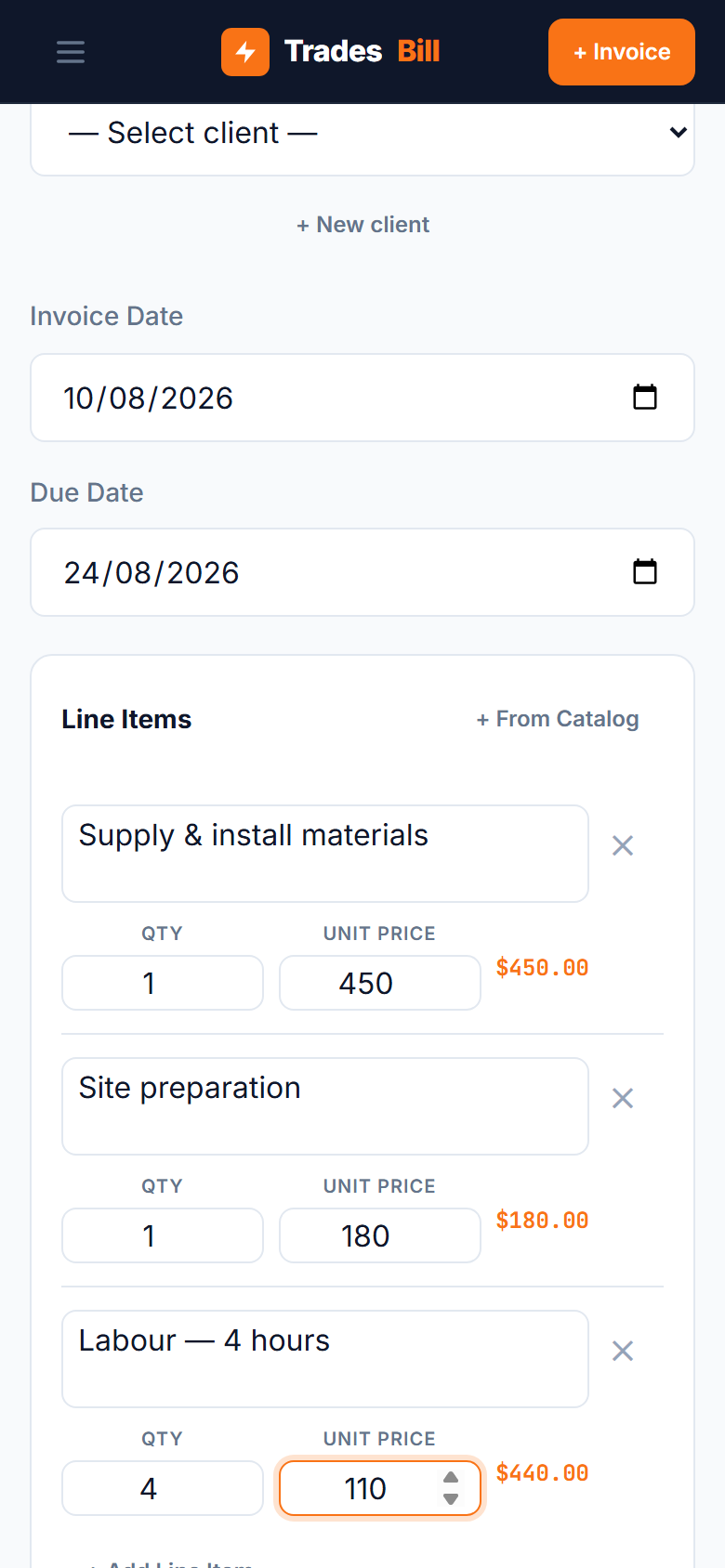
Whichever you choose, the fee only works if your invoices are clear about the due date and terms in the first place. A good free invoice app for tradies lets you set your payment terms once and have them appear automatically on every invoice, so you're never relying on memory to stay consistent.
Set your payment terms once, apply them every time
TradesBill lets you add payment terms and due dates to every invoice automatically, and flags overdue invoices the moment they cross the line. Free forever, works offline.
Create your first invoice — FreeFrequently asked questions
Can I add a late fee to an invoice that's already overdue?
Only if your original quote, contract, or invoice already disclosed the fee before the due date passed. You can't retroactively add a fee that was never agreed to.
Is there a legal maximum for late payment interest in Australia?
There's no single national cap for commercial invoices between a tradie and a client, but the fee or rate must be reasonable and reflect a genuine cost, not an excessive penalty. Unreasonably high fees risk being unenforceable.
Do I need a written contract to charge a late fee?
Not necessarily — a clearly worded quote or invoice that the client accepted can be enough. But a written contract or terms and conditions document makes your position much stronger if a client ever disputes the fee.
Should I charge GST on a late payment fee?
Usually not — genuine late fees and interest are typically treated as compensation, not a taxable supply, so they're generally GST-free. Confirm with a registered tax agent if your fee structure is unusual.
What if the client refuses to pay the late fee?
Don't let a disputed late fee hold up recovery of the original invoice amount. Pursue the underlying debt first, and raise the late fee separately — referencing your original terms — once the main payment issue is resolved.