The Australian financial year ends on 30 June, and for most tradies it arrives at the worst time — mid-winter, flat out, with a ute full of receipts. This EOFY checklist for tradies breaks the job into what to do before 30 June, what to do in July, and which deadlines follow. Work through it in May and June and you'll hand your accountant a tidy file instead of a shoebox.
It's written for sole traders and small trade businesses. If you have a company or trust structure, most of it still applies, but talk to your accountant about the extra steps.
Note: TradesBill is not a registered tax agent. This checklist is general information, not tax advice. Deadlines and thresholds change — check ato.gov.au and confirm your situation with a registered tax agent or BAS agent.
EOFY checklist for tradies — before 30 June
These are the jobs that have to happen inside the financial year to count. Leave them until July and you've missed them.
1. Chase every unpaid invoice
Go through your invoice list and follow up anything overdue. Cash in the bank on 30 June is easier to plan around than money you're still waiting on. Our guide on how to follow up an unpaid invoice has email templates you can copy.
2. Write off bad debts you'll never collect
If a client is never going to pay, you may be able to claim the unpaid amount as a bad debt — but generally only if you've already counted it as income and you formally write it off before 30 June. Make a written record of the decision and the date. If you're registered for GST and account on an accruals basis, you may also be able to claim back the GST you paid on that invoice. Check the details with your accountant.
3. Buy what you genuinely need
Tools, equipment and work gear bought and used (or installed ready for use) before 30 June can usually be claimed this year. Small businesses may be able to write off eligible assets immediately under the instant asset write-off — the threshold and rules change, so check the current figure on the ATO website before you buy. Don't buy something you don't need just for the deduction: you're still spending the money.
4. Consider prepaying some expenses
Small businesses can often claim prepaid expenses that cover a period of 12 months or less — for example, a year of insurance or a professional membership paid in June. Ask your accountant whether it makes sense for you.
5. Make personal super contributions (if it suits you)
As a sole trader, nobody pays super for you. You may be able to claim a tax deduction for personal contributions you make, but the money has to reach your fund before 30 June — not just leave your account — and you need to lodge a notice of intent to claim with your fund and get it acknowledged before you lodge your tax return. Contribution caps apply.
6. Pay employees' super on time
If you employ anyone, make sure their super guarantee payments are up to date and reach the fund by the due date. Super is only deductible in the year the fund receives it.
7. Do a stocktake if you carry stock
If you hold trading stock — say, a store of fittings, tiles or cable you resell on jobs — you may need to count and value it at 30 June. Small businesses may not need a full stocktake if the value hasn't changed much; check the rules with your accountant.
Get your records in order for EOFY
Your accountant can only claim what you can prove. Before you hand anything over, pull together:
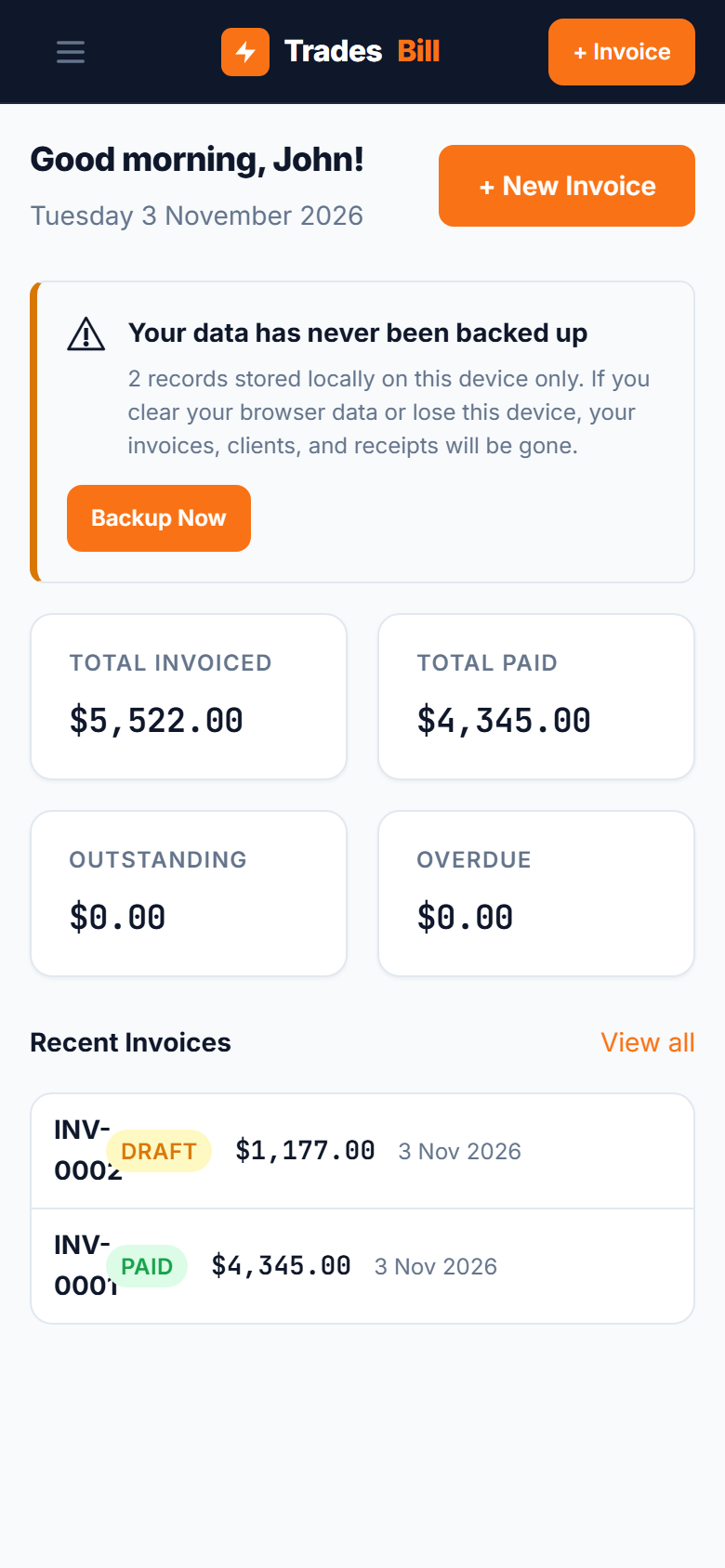
- All invoices issued for the year, with GST shown separately if you're registered. If you invoice in TradesBill, they're already in one place.
- All business receipts — materials, fuel, tools, insurance, licences, phone. Snap photos of paper receipts before they fade.
- Bank statements for every account the business uses.
- Vehicle records — a logbook if you use the logbook method, or a record of work kilometres if you use cents per kilometre.
- Home office records if you do admin from home.
- Asset purchases over the year, with dates and receipts.
- Payments to subcontractors, with their ABN and the amounts paid.
Keep these records for five years — that's the ATO's general record-keeping requirement. Not sure what you can claim? See our guide to tax deductions for tradies.
EOFY deadlines for tradies — July to October
Once 30 June passes, the deadlines start. These are the standard dates for self-lodgers; lodging through a registered tax agent or BAS agent can give you later due dates.
| Due date | What's due | Who it applies to |
|---|---|---|
| 14 July | Single Touch Payroll finalisation | Tradies with employees |
| 28 July | April–June quarter BAS | Quarterly BAS lodgers |
| 28 August | Taxable payments annual report (TPAR) | Building and construction businesses that pay contractors |
| 31 October | Individual tax return | Sole traders lodging themselves |
The TPAR catches a lot of tradies out. If your business is mainly building and construction and you pay subcontractors, you'll likely need to report those payments each year. That's why you should keep every subbie's ABN and payment amounts on file.
For a walkthrough of the June-quarter BAS, read how to do your BAS as a sole trader.
Set up the new financial year properly
1 July is a clean slate. A few small changes now save a lot of pain next June:
- Review your prices. Materials and fuel costs go up — make sure your hourly rate and call-out fee keep pace.
- Check your GST status. If your turnover is getting close to $75,000, read up on the GST registration threshold so you register on time.
- Separate business and personal spending with a dedicated business account, if you haven't already.
- Start a fresh vehicle logbook if yours is more than five years old or your work use has changed.
- Record expenses as you go instead of saving them for June.
- Set aside tax every time you're paid — a percentage into a separate account so the tax bill isn't a shock.
How TradesBill helps at tax time
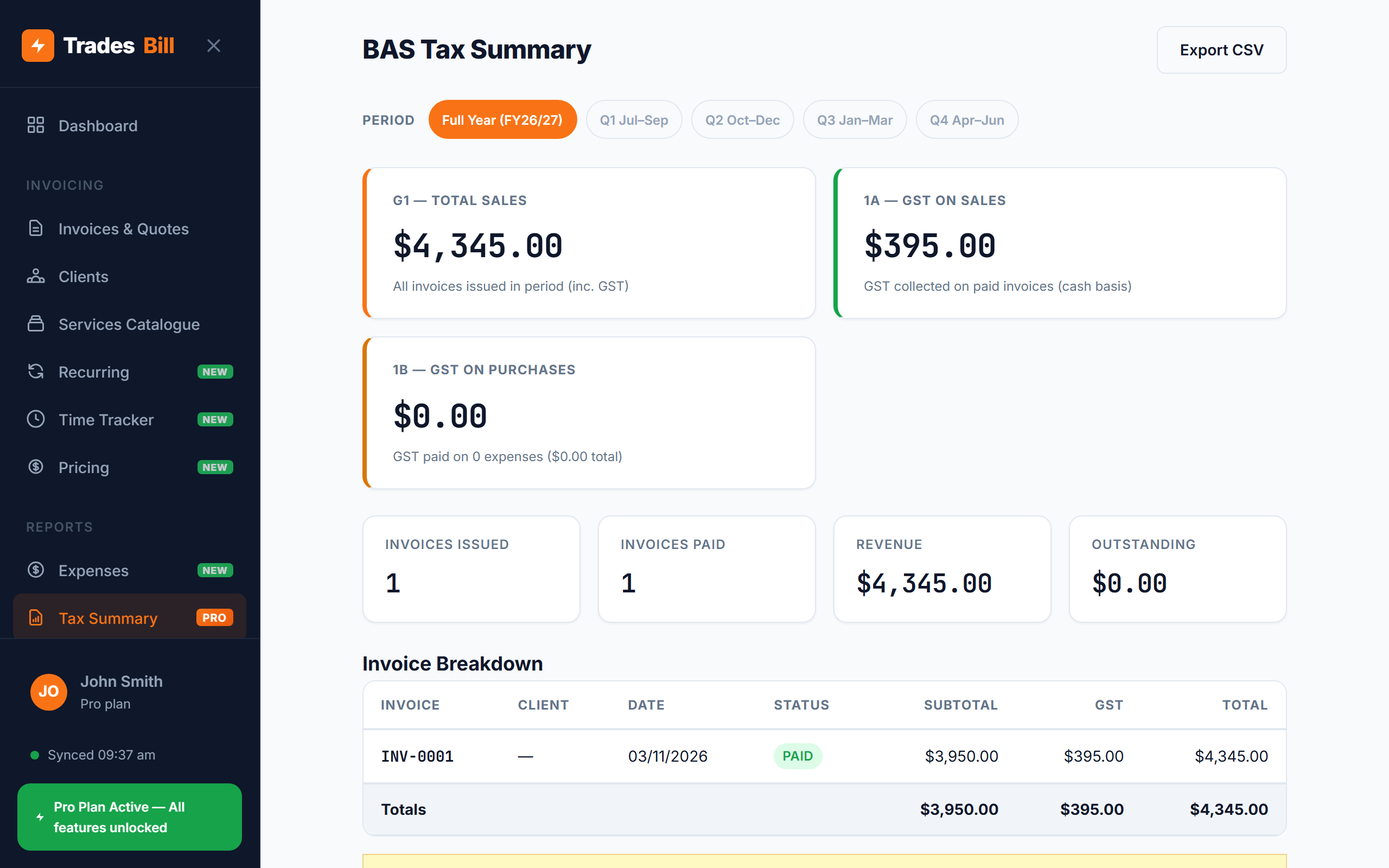
TradesBill is a free invoice app for tradies. Every invoice you send is stored with its GST broken out, so at EOFY you're not hunting through emails and PDFs for what you billed. You can log business expenses in the app, and Pro users get a Tax Summary report that totals your sales, GST collected and GST paid on logged expenses for any quarter or the full year — a handy starting point for your BAS and a useful summary to hand your accountant.
Make next EOFY easier
Invoice in TradesBill all year and your income and GST records are ready when 30 June comes around. Free to start, works offline.
Start free — no credit card neededFrequently asked questions
When does the financial year end in Australia?
The Australian financial year runs from 1 July to 30 June. The 2026–27 financial year ends on 30 June 2027.
When is my tax return due as a sole trader?
If you lodge yourself, your individual tax return (which includes your business income) is generally due by 31 October. If you use a registered tax agent and you're on their client list before then, you may get a later due date.
Can I claim a tool I buy on 30 June?
Generally, yes — if you buy it and start using it (or have it ready to use) for work by 30 June, it counts for that year. If it's only ordered and not delivered, it may not. Check with your accountant for anything large.
What if I've missed an EOFY deadline?
Lodge as soon as you can and contact the ATO or a registered tax agent. The ATO can charge penalties for late lodgement, but getting in early and talking to them usually helps.