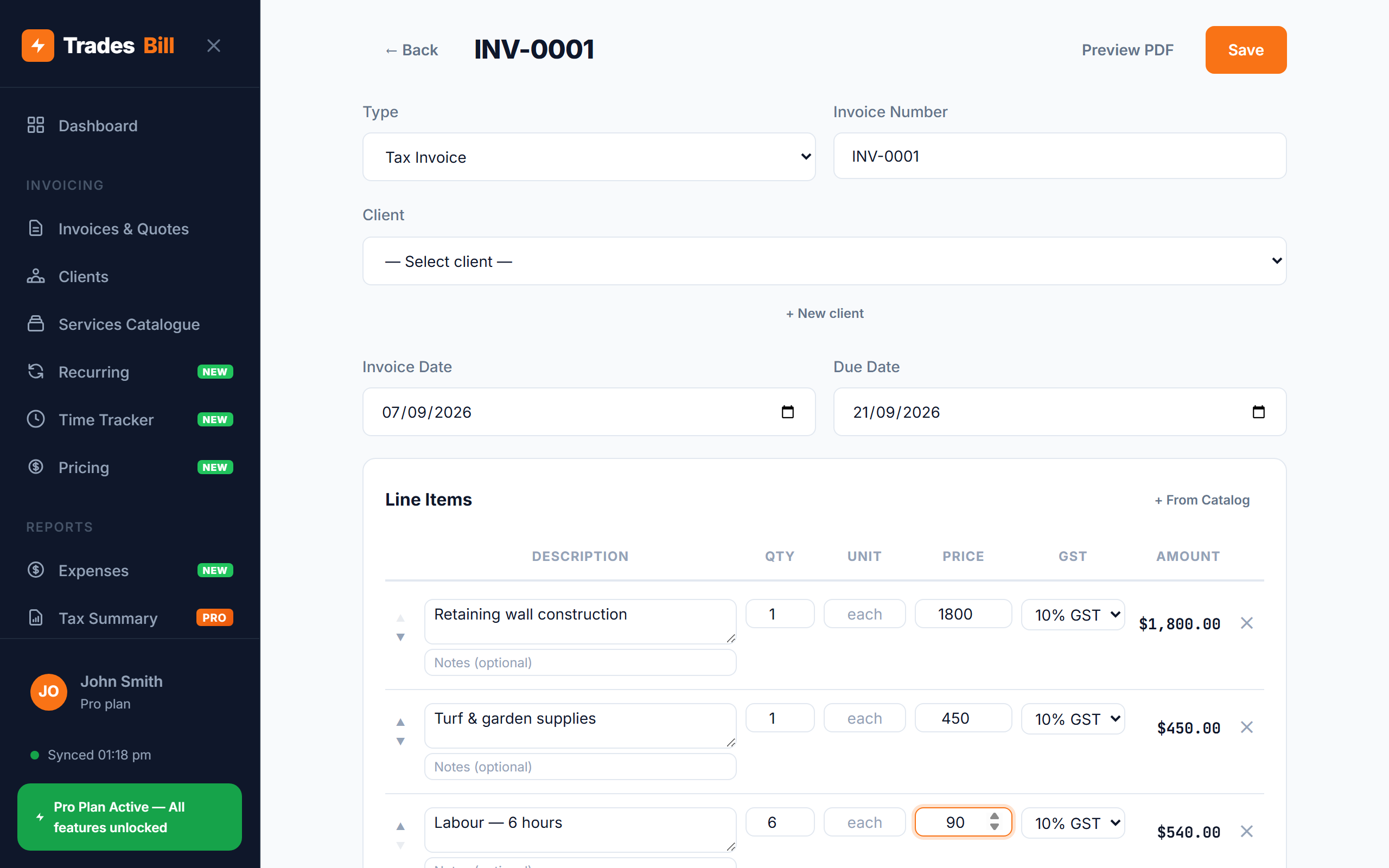
Learning how to invoice as a landscaper in Australia comes down to getting a handful of things right every time: an ATO-compliant Tax Invoice, clear line items for plants, materials and labour, and a GST breakdown your customer can actually understand. Get the template right once and every job after that is just filling in the blanks.
This guide covers exactly what to include on a landscaping invoice, how to handle plant and materials costs, sample line items for the jobs you quote most often, and the mistakes that hold up payment.
How to invoice as a landscaper — what every invoice needs
If you're GST-registered (compulsory once your annual turnover reaches $75,000), every invoice you issue must be a valid Tax Invoice. At minimum, that means including:
- The words "Tax Invoice" — clearly labelled, not just "Invoice".
- Your business name — matching your ABN registration.
- Your ABN — your 11-digit Australian Business Number.
- Invoice date — the date you issue the invoice, not the date the job finished.
- A unique invoice number — sequential numbering keeps your job records straight across a busy planting season.
- Customer name and job address — required for invoices over $1,000, and worth including on every job so there's no confusion about which property the work was done at.
- Description of the work — itemised line items for prep, materials, plants and labour.
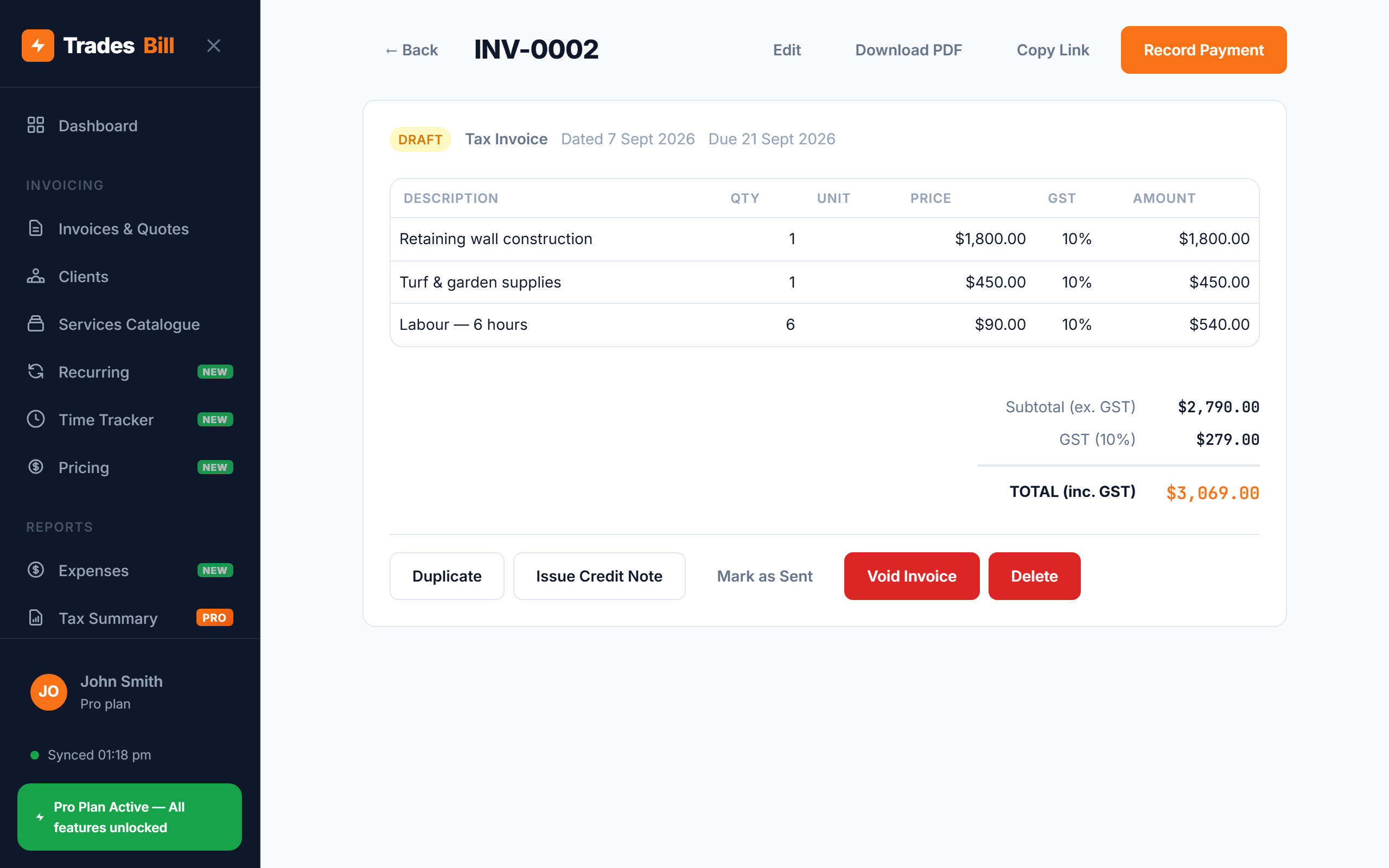
- GST amount — shown as a separate line, not folded into the total.
- Total amount due — including GST.
- Payment terms — when payment is due (e.g. on completion, or 7 days).
Tip: Landscaping jobs often mix a big upfront materials spend (turf, soil, pavers) with labour spread over several days. Build your invoice as you go — recording deliveries and hours per day — rather than trying to reconstruct the whole job from memory at the end.
Garden maintenance vs construction vs turf — how invoicing differs
Garden maintenance — mowing, pruning, weeding, mulching — is usually a recurring job, best invoiced on a set schedule (weekly, fortnightly or monthly) rather than after every single visit, so your customer gets a predictable, easy-to-process bill.
Landscape construction — retaining walls, paving, decking, garden beds — is usually priced per job and often needs a deposit before materials are ordered, since pavers, sleepers and soil can be a significant upfront cost.
Turf and irrigation installation — supply and lay turf, irrigation systems, drainage — is typically a one-off job invoiced on completion, with materials (turf rolls, pipe, fittings) itemised separately from labour so the client can see exactly what they paid for.
Plant and materials costs for landscapers
Landscaping invoices often carry a bigger materials component than other trades — turf, soil, mulch, pavers, plants and retaining wall sleepers all add up fast. Two things matter more than exactly how you price it:
- Itemise plants and materials separately from labour. A client who sees "Landscaping — $4,200" has no idea what they're paying for. Breaking it into turf, soil, plants and labour builds trust and makes disputes far less likely.
- Apply your markup consistently. Most landscapers mark up nursery stock and hard materials by 15–30% to cover selection time, transport and wastage — just be upfront about it in the quote so the invoice doesn't come as a surprise.
How to invoice for common landscaping jobs
Here are sample line items for jobs landscapers bill every week. Adjust pricing, quantities and areas to suit your rates and the scope of the job.
Garden makeover / new garden bed
- Site prep — clearing, weeding, soil turning
- Supply and install garden edging — [linear metres]
- Supply and spread garden soil/mulch, [cubic metres]
- Supply and plant [number] plants, [size/species]
- Labour — [hours] hours at $[rate]/hr
Turf installation
- Site prep — level, remove old lawn, spread topsoil
- Supply and lay turf, [square metres]
- Supply and install irrigation/drip line (if applicable)
- Labour — [hours] hours
Paving or retaining wall
- Excavation and base preparation — [square/linear metres]
- Supply and lay pavers/sleepers, [area or linear metres]
- Drainage and backfill
- Labour — [hours] hours at $[rate]/hr
Ongoing garden maintenance
- Mowing and edging — [property address]
- Hedge and shrub pruning
- Weeding and mulch top-up
- Green waste removal
Irrigation system install or repair
- Supply and install irrigation controller and zones
- Supply and lay pipe and sprinkler/drip fittings — [linear metres]
- Labour — [hours] hours
- Callout fee (for repairs)
How to handle GST on landscaping invoices
If you're registered for GST, you charge 10% on top of both labour and materials — including any plants, turf, pavers or mulch built into your price. Your invoice must show the GST amount separately from the subtotal, followed by the total amount due.
If your turnover is under the GST registration threshold of $75,000 and you haven't voluntarily registered, don't add a GST amount at all — and don't use the words "Tax Invoice" on your invoices, since that label is reserved for GST-registered businesses.
Note: If a job involves a large materials order — a truckload of turf or a pallet of pavers — consider invoicing a deposit to cover the materials cost before you place the order. That way you're not carrying the cost of the client's garden on your own credit card.
Common invoicing mistakes landscapers make
- Lumping all materials into one vague line — "Materials — $1,800" tells the client nothing. Break out turf, soil, plants and hard materials separately so they can see the breakdown.
- Not invoicing a deposit on materials-heavy jobs — fronting the cost of pavers or turf yourself puts unnecessary strain on your cash flow.
- Forgetting to bill for green waste removal or tip fees — these are real costs that are easy to forget once the job's finished and the ute's already been to the tip.
- Invoicing maintenance jobs ad hoc — recurring mowing and garden care is much easier to manage (and get paid for) as a scheduled recurring invoice rather than a one-off invoice after every visit.
- Forgetting the GST breakdown — see our GST calculation guide for the two quick formulas.
- Using paper quotes and handwritten invoices on site — easy to lose in the ute, and slower to turn into a proper Tax Invoice at the end of the day.
Invoice like a professional landscaper — for free
TradesBill is a free invoice app for tradies. Add your ABN and bank details once — then create ATO-compliant Tax Invoices on site in under 60 seconds, whether it's a one-off garden makeover or a recurring mow. Free forever, works offline.
Create your first invoice — FreeFrequently asked questions
Do I need a licence to invoice as a landscaper?
Requirements vary by state — general garden maintenance usually doesn't require a licence, but structural landscaping work like retaining walls over a certain height may need council approval or a licensed contractor. Check with your state's building or fair trading authority for the rules that apply where you work.
Do I need an ABN to invoice as a landscaper?
Yes. To invoice as a business in Australia you need an ABN — without one, your customers are required to withhold 47% of the payment and send it to the ATO. Register for free through the Australian Business Register.
Should I invoice a deposit before starting a landscaping job?
It's common practice for larger construction jobs, especially where you need to order turf, pavers or plants upfront. A deposit of 20–50% is typical, but always set this out in your quote before work begins.
How should I invoice recurring garden maintenance?
Set up your invoices on a fixed schedule (weekly, fortnightly or monthly) rather than invoicing after every mow — it's less admin for you and gives the client a predictable bill.
What if plant stock or material prices change between the quote and the job?
Nursery and hard materials prices can shift, especially for jobs booked weeks in advance. If costs go up significantly, let the client know before you proceed and add the difference as its own line item on the invoice so the change is clearly documented.