Knowing how to invoice as a builder in Australia is more involved than most trades — you're often dealing with progress claims, retention, variations, and subcontractor invoices on top of the standard ATO Tax Invoice requirements. Get the structure wrong and you can delay payment by weeks, or worse, hand a client grounds to dispute the claim.
This guide covers everything a builder needs to know about invoicing in Australia — from the fields the ATO requires, to how to structure progress claims and handle retention, to real line-item examples you can copy for common building jobs.
How to invoice as a builder — what every invoice needs
If you're GST-registered (required once your annual turnover hits $75,000), every invoice or progress claim you send must be a valid Tax Invoice. That means it must include:
- The words "Tax Invoice" — clearly labelled at the top.
- Your business name — as registered with the ATO.
- Your ABN — your 11-digit Australian Business Number.
- Your builder's licence number — not an ATO requirement, but expected by clients, owners, and building certifiers on every invoice.
- Invoice date — the date you issued the invoice or claim.
- A unique invoice number — sequential numbering (e.g. INV-001, INV-002) keeps your bookkeeping and job costing clean.
- Customer name and site address — required for invoices over $1,000, and essential when you're running multiple jobs at once.
- Description of work — itemised line items, or a reference to the contract stage being claimed.
- GST amount — shown separately from the subtotal.
- Total amount due — including GST, and net of any retention withheld.
- Payment terms — when payment is due, and any reference to the building contract clause it relates to.
Tip: Include your builder's licence number and contract reference (e.g. "Contract #2026-014") on every invoice. Owners, building surveyors, and lenders often need to match invoices back to the signed contract, and a missing reference is a common reason progress claims get bounced back for clarification.
Progress claims vs standard invoices
Most building contracts over a certain value are paid in stages rather than as one lump sum at the end. This is a progress claim — an invoice for a percentage of the contract price tied to a defined stage of work, rather than a one-off job.
A progress claim should reference:
- The building contract number and date
- The stage being claimed (e.g. "Slab down", "Frame complete", "Lock-up", "Fixing", "Practical completion")
- The percentage or dollar value of the contract this stage represents
- The cumulative amount claimed to date across all previous progress claims
- Any retention withheld from this claim
Standard residential building stages (based on the typical HIA/Master Builders contract structure) are:
| Stage | Typical % of contract |
|---|---|
| Deposit | 5-10% |
| Base/slab down | 10-15% |
| Frame complete | 15-20% |
| Lock-up (roof, external walls, windows) | 20-25% |
| Fixing (kitchen, bathroom, internal linings) | 20-25% |
| Practical completion | 5-10% |
Always check the exact percentages against your specific contract — they vary by state, contract type, and what your client negotiated.
How to handle retention on builder invoices
Retention is an amount withheld by the client (typically 5% of the contract value, sometimes split as 2.5% at practical completion and 2.5% at the end of a defects liability period) as security against defects. It's common on commercial and larger residential jobs.
When retention applies, show it clearly on the invoice rather than just reducing the total:
| Description | Amount |
|---|---|
| Progress claim 4 — Lock-up stage, Contract #2026-014, 22 Ridgeline Ave, Berwick | $68,000.00 |
| Less: retention (5%) | -$3,400.00 |
| Subtotal (ex GST) | $64,600.00 |
| GST (10%) | $6,460.00 |
| Total due | $71,060.00 |
Note: GST is generally calculated on the full claim amount before retention is deducted, since GST applies to the value of the supply, not the cash you actually receive. Keep a running ledger of retention withheld per contract so you know exactly what's owed to you at practical completion and at the end of the defects liability period — it's easy to lose track across multiple jobs.
How to invoice for variations
A variation is any change to the original scope of work — an upgrade the client requested, an unexpected site condition, or a design change. Variations should always be invoiced separately from the base progress claim, never bundled in, so both you and the client have a clear record of what changed and why.
Before invoicing a variation:
- Get it in writing first — a signed variation form or email confirmation before you start the extra work, not after.
- Reference the variation number on the invoice (e.g. "Variation 3 — upgrade to stone benchtops").
- Show the cost breakdown — labour and materials for the variation, separate from the base contract price.
- Note the revised contract value if the variation changes the total contract sum.
Sample variation line item: "Variation 3 (approved 12/05/2026) — supply and install upgraded 40mm stone benchtop to kitchen and island, in lieu of standard laminate as per original specification — $2,850.00 + GST".
How to invoice for common building jobs
Here are sample line-item descriptions builders use every day. Adapt these to suit your pricing and the scope of each job.
New home build — deposit
- Deposit — 5% of contract price, Contract #[number], [site address]
- Covers preliminary works: council approvals, site establishment, and scheduling
Renovation — kitchen and bathroom
- Demolition and removal of existing kitchen and bathroom fixtures
- Supply and install new kitchen joinery, benchtop, and splashback
- Supply and install bathroom vanity, shower screen, and fittings
- Coordination of plumbing, electrical, and tiling subcontractors
- Waste removal and site clean
Deck or pergola build
- Supply and install [material] decking, [dimensions]
- Footings and subframe construction
- Balustrade and handrail installation (if required by height)
- Council permit lodgement (if applicable)
Granny flat / secondary dwelling
- Progress claim — [stage], Contract #[number]
- Includes: [slab/frame/lock-up/fixing — as applicable to stage]
- Less: retention ([%])
Subcontractor invoice to head contractor
- Labour and materials for [trade] work at [site address] — as per purchase order [number]
- Reference to the head contractor's job number or PO number
How to invoice as a subcontractor to a builder
If you're a subcontractor invoicing a head builder rather than the homeowner, the rules are slightly different. You'll still need a valid Tax Invoice, but you should also:
- Reference the purchase order or job number the builder gave you — most builders won't process an invoice without one.
- Check payment terms in your subcontract agreement — commonly 30 days, sometimes tied to the builder receiving payment from their client ("pay when paid" clauses, which are restricted or banned in some states' security of payment legislation).
- Know your security of payment rights — each state has security of payment legislation (e.g. the Building and Construction Industry Security of Payment Act) that gives subcontractors a fast-track process to claim and recover payment for building work. If a builder doesn't pay or respond to your payment claim within the legislated timeframe, you may have a statutory right to payment regardless of other contract terms.
How to handle GST on builder invoices
If you're registered for GST, you charge 10% on top of your prices — on both labour and materials. Two things builders should watch for:
- GST on progress claims: GST is calculated on the full claim value (before retention is deducted), not on the net amount you actually receive.
- GST on variations: Charge GST on the variation amount just as you would on the base contract — don't forget it when quoting variations verbally on site.
Your invoice must show the GST amount separately — as a subtotal, GST line, then total. If your turnover is under the GST registration threshold of $75,000 and you're not voluntarily registered, don't show a GST amount at all.
Common invoicing mistakes builders make
- Not referencing the contract or PO number — makes it hard for the client or head builder to match your claim to their records, which delays payment.
- Bundling variations into the base progress claim — always show variations as separate line items so both parties have a clear record.
- Losing track of retention — without a running ledger per contract, it's easy to forget what's owed to you months later.
- Claiming more than the contract allows for a stage — over-claiming is a common trigger for disputes and delayed payment.
- Not invoicing promptly at each stage — the longer you wait after reaching a milestone, the longer the payment cycle stretches out.
- Missing the GST breakdown — your invoice must show the GST amount, not just the total. See our GST calculation guide.
- Using spreadsheets or handwritten claims — hard to track across multiple jobs and contract stages. A proper invoicing app keeps every job, claim, and retention balance organised.
Invoice like a professional builder — for free
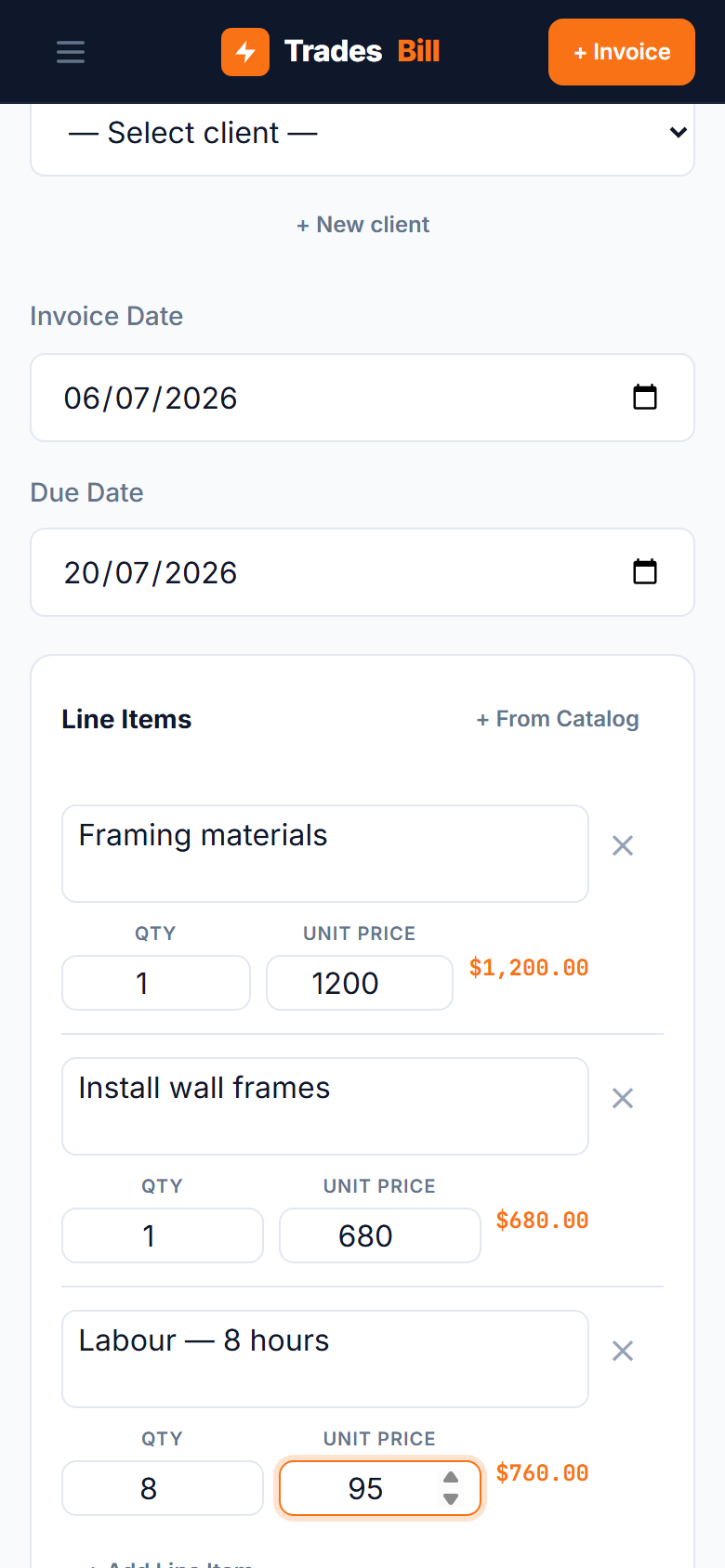
TradesBill is built for Australian tradies. Add your ABN, licence number, and bank details once — then create ATO-compliant Tax Invoices and progress claims in under 60 seconds. Free forever, works offline.
Create your first invoice — FreeFrequently asked questions
Do I need an ABN to invoice as a builder?
Yes. To invoice as a business in Australia you need an ABN. Without one, your customers must withhold 47% of the payment amount and send it to the ATO. Get your ABN through the Australian Business Register.
How much retention can a client withhold?
There's no single national rule — retention amounts and release conditions are set out in your building contract. 5% is common on residential jobs, sometimes released in two halves: at practical completion and at the end of the defects liability period (often 3-12 months later). Always check your specific contract.
Can I invoice for a deposit before starting work?
Yes, and it's standard practice — most residential building contracts include a deposit (commonly 5-10%, though state regulations may cap this) payable before work begins, to cover initial approvals and mobilisation costs.
What happens if a client disputes a progress claim?
Most building contracts set out a dispute resolution process. In the meantime, each state's security of payment legislation gives you a statutory pathway to claim and recover payment for work completed, separate from the general contract dispute process. Clear, itemised invoices with contract references reduce the chance of disputes in the first place.
Do I charge GST on retention that hasn't been paid to me yet?
Generally, GST is payable on the full value of the supply when you issue the tax invoice, regardless of when the retention is actually released to you. This is a common area of confusion — TradesBill is not a registered tax agent, so check with your accountant or BAS agent on how this applies to your specific circumstances.
What's the best way to send progress claims and variations?
PDF by email is the standard for builders, since claims often need to be attached to project files or forwarded to a client's bank or lender. With TradesBill, you tap "Share" on any invoice to generate a PDF and send it via email straight from site.