Knowing how to invoice as a plumber in Australia is essential if you want to get paid on time, keep the ATO happy, and look professional doing it. Whether you're a sole-trader plumber doing residential call-outs or running a team across commercial sites, every invoice you send represents your business.
This guide covers everything an Australian plumber needs to know about invoicing — from the fields the ATO requires on a Tax Invoice, to how to invoice for materials and labour, to real line-item examples you can copy for common plumbing jobs.
How to invoice as a plumber — what every invoice needs
If you're GST-registered (required once your annual turnover hits $75,000), every invoice you send must be a valid Tax Invoice. That means it must include:
- The words "Tax Invoice" — clearly labelled at the top.
- Your business name — as registered with the ATO.
- Your ABN — your 11-digit Australian Business Number.
- Your plumbing licence number — not an ATO requirement, but customers and builders expect to see it. Include it in your business details.
- Invoice date — the date you issued the invoice.
- A unique invoice number — sequential numbering (e.g. INV-001, INV-002) keeps your bookkeeping clean.
- Customer name and address — required for invoices over $1,000.
- Description of work — itemised line items covering labour, materials, and any other charges.
- GST amount — shown separately from the subtotal.
- Total amount due — including GST.
- Payment terms — when payment is due (e.g. "Due within 14 days").
Tip: Including your plumbing licence number on every invoice builds trust and is expected by property managers, builders, and real estate agents. Most states require licensed plumbers to display their licence number on business documents and advertising.
How to invoice for plumbing work — labour vs materials
Most plumbing jobs involve both labour and materials. You have two ways to present these on your invoice:
Option 1: Separate labour and materials (recommended)
List labour hours and materials as separate line items. This is what builders and commercial clients expect, and it makes your invoice transparent and easier to approve.
| Description | Qty | Rate | Amount |
|---|---|---|---|
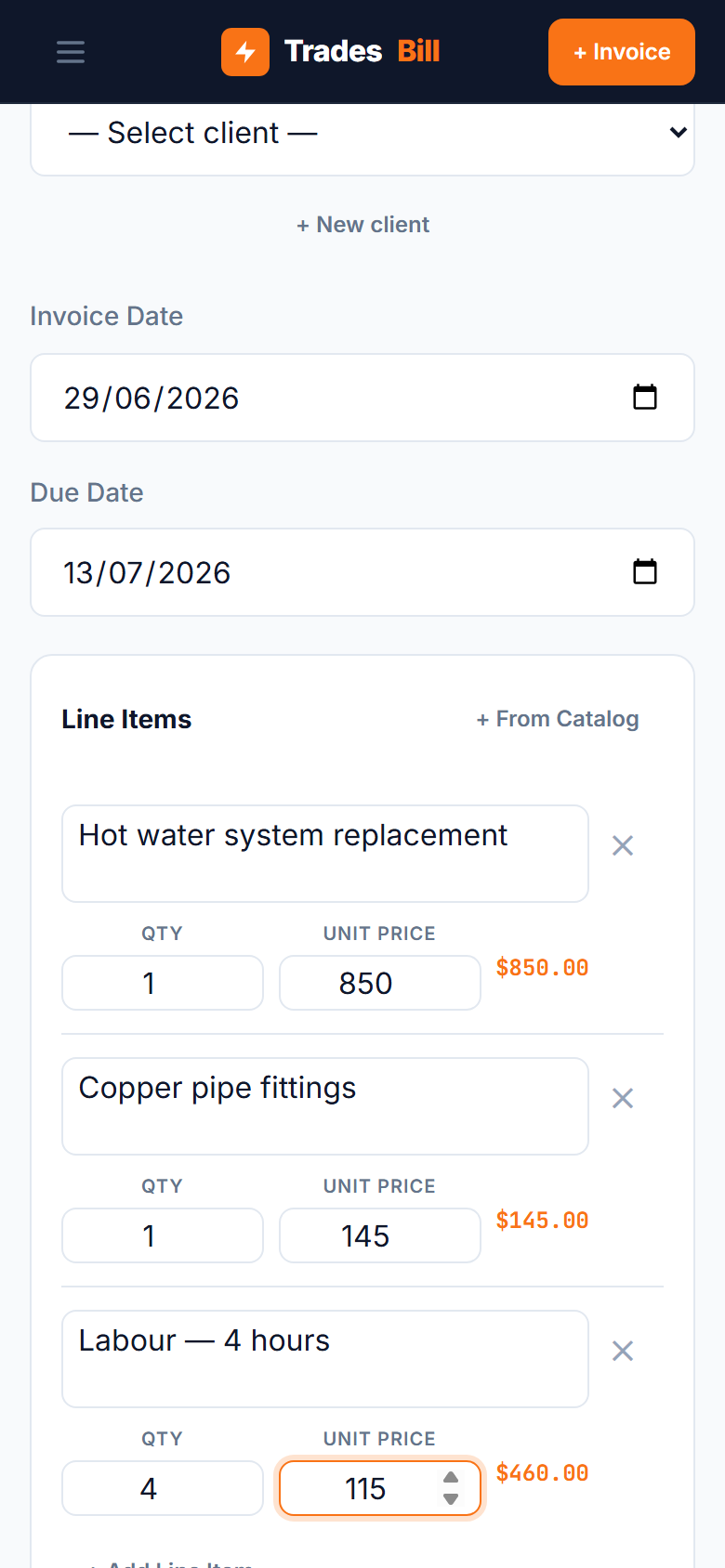
| Hot water system replacement — disconnect and remove old 250L electric, install new 250L Rheem electric HWS, connect to existing pipework | 4 hrs | $110.00 | $440.00 |
| Rheem 250L electric hot water system (supplied) | 1 | $980.00 | $980.00 |
| Tempering valve (TMV) | 1 | $85.00 | $85.00 |
| Sundry materials (copper fittings, braided hoses, PTFE tape) | 1 | $65.00 | $65.00 |
| Removal and disposal of old hot water unit | 1 | $80.00 | $80.00 |
| Subtotal (ex GST) | $1,650.00 | ||
| GST (10%) | $165.00 | ||
| Total (inc GST) | $1,815.00 | ||
Option 2: Single line item per job
For quick residential jobs — say, replacing a tap washer — a single line item like "Supply and replace mixer tap washers in bathroom — $165 + GST" is fine. But for anything over a few hundred dollars, itemising builds trust and reduces disputes.
How to invoice for plumbing compliance certificates
In most Australian states, certain plumbing work requires a compliance certificate or notification to the relevant authority. This is a legal requirement, not an optional extra, so it's fair to include the cost on your invoice.
The requirements vary by state:
- NSW: Plumbers must lodge a Certificate of Compliance (CoC) with NSW Fair Trading within 2 business days for regulated work (hot water, gas, backflow, drainage, etc.).
- VIC: A Compliance Certificate must be issued for plumbing and drainage work. The plumber gives a copy to the building owner and the relevant council.
- QLD: A Form 4 (Compliance Certificate) is required for notifiable plumbing work. The plumber lodges it with the local council.
- SA: Plumbers must lodge a Notice of Completion with SA Water or the relevant authority for regulated work.
- WA: Plumbing compliance is managed through the Plumbers Licensing Board. Certain work requires a Notice of Intention before starting and certification on completion.
The simplest approach: add a line item like "Compliance certificate (CoC) — $55" so the customer can see the cost. Don't absorb it into your labour rate.
How to handle GST on plumber invoices
If you're registered for GST, you charge 10% on top of your prices. GST applies to both your labour and the materials you supply. Here's how it works:
- Labour: Your hourly rate is ex-GST. If your rate is $110/hr, the customer pays $110 + $11 GST = $121 per hour.
- Materials: You've already paid GST when you bought the materials from your supplier. You claim that GST back from the ATO (input tax credit), then charge your customer GST on the price you sell the materials for. The customer's GST is based on what you charge, not what you paid.
Your invoice must show the GST amount separately — either as a line on each item or as a single total at the bottom. Most plumbers show a subtotal (ex GST), a GST line, then the total (inc GST).
Not registered for GST? If your annual turnover is under $75,000 and you're not voluntarily registered, you don't charge GST and your invoices should say "No ABN — not registered for GST" or simply not mention GST. Never show a GST amount if you're not registered. See our guide on the GST registration threshold if you're unsure whether you need to register.
How to invoice for common plumbing jobs
Here are sample line-item descriptions for jobs plumbers handle every day. Adapt these to suit your pricing and the scope of each job.
Hot water system replacement
- Disconnect and remove existing HWS — dispose of old unit
- Supply and install [brand] [capacity] [type] hot water system
- Supply and install tempering valve (TMV)
- Connect to existing hot and cold water pipework
- Test and commission
- Compliance certificate (CoC)
Blocked drain clearing
- Attend site and diagnose blockage — [location]
- Clear blocked drain using electric eel / high-pressure jetter
- CCTV drain inspection (if applicable)
- Flush and test drainage system
Bathroom renovation — rough-in
- Strip out existing plumbing fixtures
- Relocate water supply points for new vanity, shower, and toilet
- Relocate drainage for new layout
- Install waterproofing flanges and shower waste
- Pressure test all new pipework
- Compliance certificate (CoC)
Tap or mixer replacement
- Remove existing tap/mixer — [location]
- Supply and install [brand/model] mixer tap
- Connect to existing water supply and test
Gas fitting
- Supply and install gas bayonet fitting — [location]
- Run new gas pipe from meter to [location]
- Pressure test gas line to AS 5601
- Gas compliance certificate
Toilet replacement
- Remove existing toilet suite and dispose
- Supply and install [brand] close-coupled toilet suite
- New pan collar, cistern connector, and supply hose
- Silicone seal and test flush
How to invoice for call-out fees and emergency plumbing
Emergency plumbing — burst pipes, overflowing drains, gas leaks — often happens after hours. Most plumbers charge a call-out fee on top of their hourly rate for emergency work.
Best practice is to make the call-out fee visible as the first line item on the invoice:
| Description | Amount |
|---|---|
| Emergency call-out fee (after hours — Saturday evening) | $180.00 |
| Locate and repair burst copper pipe under kitchen sink. Cut out damaged section, solder new copper fitting. | $220.00 |
| Sundry materials (copper pipe, fittings, solder) | $35.00 |
If you quoted the call-out fee upfront — by phone, text, or on your website — referencing it on the invoice avoids disputes. "As discussed, a $180 call-out fee applies for after-hours emergency attendance."
When to send your invoice — and payment terms
For residential work, invoice on the day you finish the job — or before you leave site. The longer you wait, the harder it is to collect. For commercial or builder work, you'll usually invoice weekly or monthly based on the contract.
Common payment terms for plumbers:
- Residential: Due on completion, or within 7 days
- Commercial: 14 or 30 days from invoice date
- Builder/subcontract work: Often 30 days (check your subcontract agreement)
- Insurance work: Follow the insurer's process — often 30 days after approval
Include your payment terms on every invoice. If you accept bank transfer, include your BSB and account number. If you use a free invoice app for tradies like TradesBill, your banking details are saved to your profile and automatically appear on every invoice.
Deposits and progress payments for larger plumbing jobs
For bigger jobs — bathroom renovations, new-build rough-ins, hot water system upgrades — it's standard to request a deposit before ordering materials. A typical structure:
- Deposit invoice: 30-50% upfront to cover materials (especially hot water systems, fixtures, and fittings)
- Progress invoice: (optional) at rough-in completion before the tiler or plasterer comes in
- Final invoice: balance due on completion of fit-off and testing
Each invoice should reference the job and note what stage it covers. For example: "Deposit — 50% of quoted price for bathroom renovation rough-in at 18 George St, Bondi. Balance due on fit-off completion."
Common invoicing mistakes plumbers make
- Not including your plumbing licence number — builders and property managers expect it, and it sets you apart from unlicensed operators.
- Vague descriptions — "Plumbing work" tells the customer nothing. Be specific: what you fixed, where, what you installed, and what brand.
- Forgetting the compliance certificate fee — if you're paying for the CoC, invoice for it. Don't quietly absorb the cost.
- Not separating labour and materials on larger jobs — transparency avoids disputes, especially with builders.
- Invoicing days or weeks late — the longer you wait, the less urgently the customer treats payment.
- Not separating GST — your invoice must show the GST amount, not just the total. See our GST calculation guide.
- Using handwritten invoices or scribbled receipts — hard to read, easy to lose, and impossible to track for your BAS. A proper invoicing app keeps everything organised and ATO-compliant.
Invoice like a professional plumber — for free
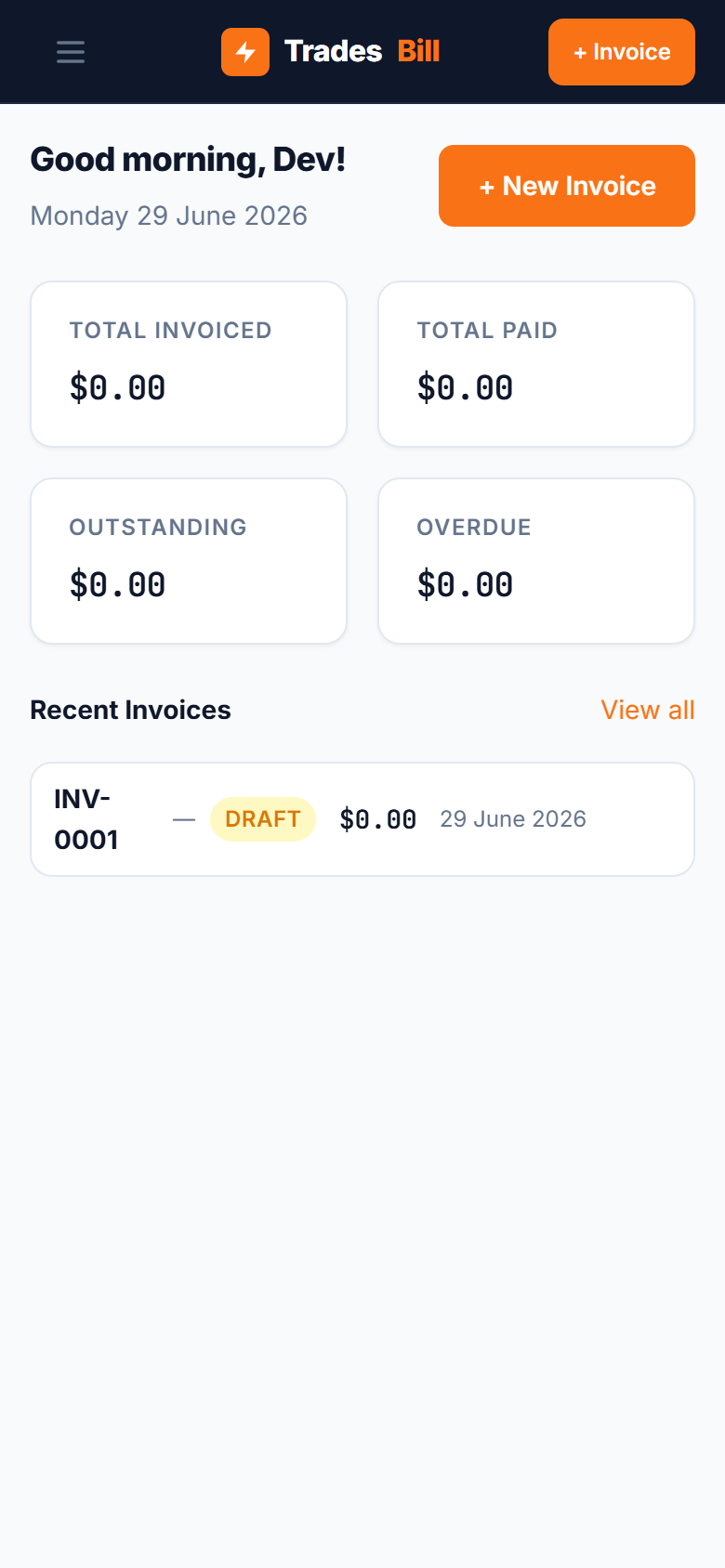
TradesBill is built for Australian tradies. Add your ABN, licence number, and bank details once — then create ATO-compliant Tax Invoices in under 60 seconds. Free forever, works offline on any device.
Create your first invoice — FreeFrequently asked questions
Do I need an ABN to invoice as a plumber?
Yes. To invoice as a business in Australia you need an ABN. Without one, your customers must withhold 47% of the payment amount and send it to the ATO. Get your ABN through the Australian Business Register.
Should I charge GST on materials I supply?
Yes, if you're GST-registered. You charge GST on the full amount — labour and materials. You'll claim back the GST you paid to your supplier as an input tax credit on your BAS.
Can I mark up materials on my plumbing invoice?
Yes — it's standard practice. Most plumbers apply a 15-30% markup on materials to cover procurement time, transport, and storage. The markup is part of your selling price, and GST is calculated on the marked-up amount.
Do I need a separate gas fitting licence to invoice for gas work?
In most states, gas fitting is a separate endorsement or licence class. You must hold the appropriate gas fitting licence to perform and invoice for gas work. Check your state's licensing requirements — in NSW it's through NSW Fair Trading, in VIC through the Victorian Building Authority, and in QLD through the QBCC.
What's the best way to send a plumbing invoice?
PDF by email or text message. With TradesBill, you tap "Share" on any invoice to generate a PDF and send it via email, text, or any messaging app — straight from your phone on site.
Do I need to include my plumbing licence number on invoices?
It's not strictly an ATO requirement for Tax Invoices, but most state plumbing regulators require you to display your licence number on business documents. Including it on every invoice is standard practice and gives customers confidence that you're properly licensed.