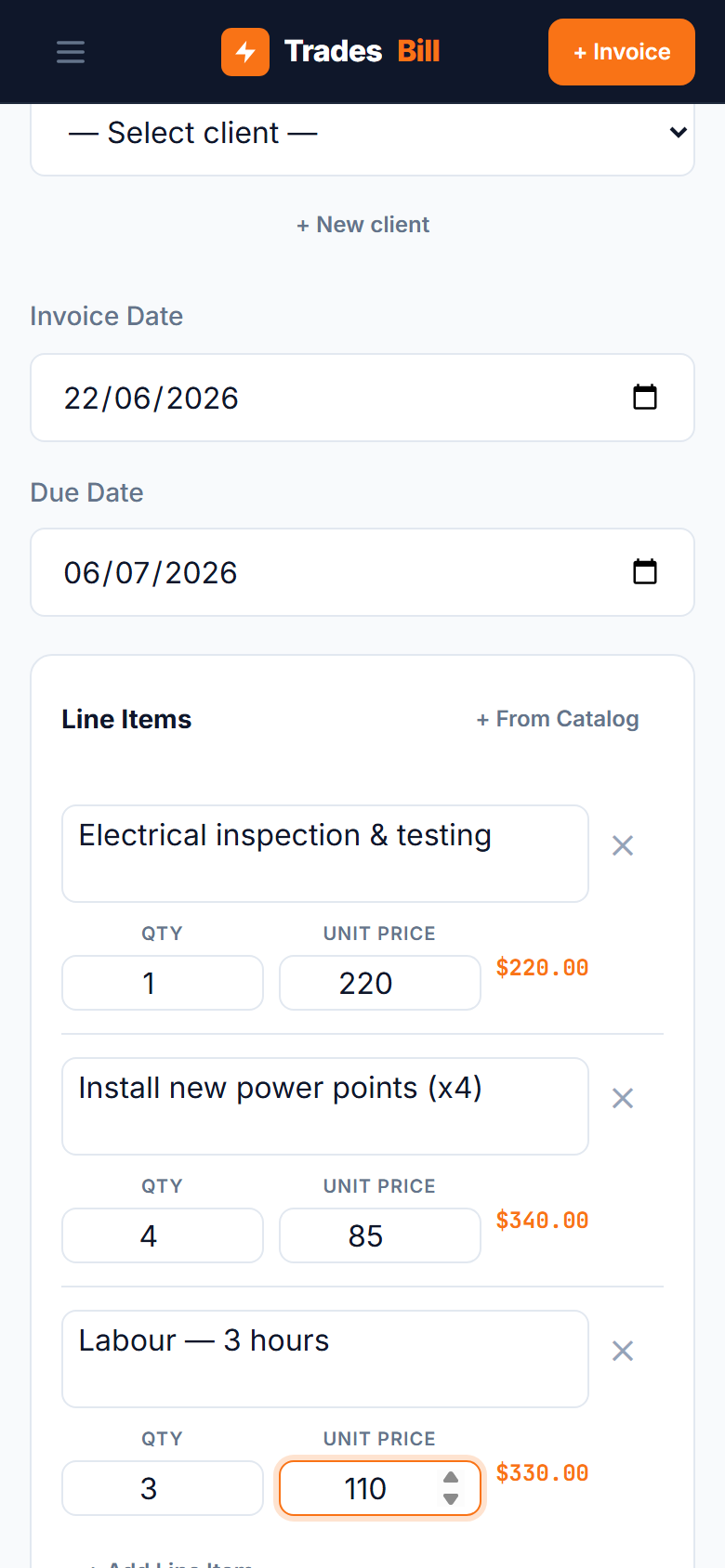
Knowing how to invoice as an electrician in Australia is just as important as knowing how to wire a switchboard. Send a sloppy invoice and you risk late payments, GST headaches, and customers who don't take you seriously. Get it right and you'll get paid faster with fewer follow-ups.
This guide covers everything an Australian sparky needs to know about invoicing — from what fields the ATO requires, to how to invoice for materials and labour, to real line-item examples you can copy.
How to invoice as an electrician — what every invoice needs
If you're GST-registered (required once your annual turnover hits $75,000), every invoice you send must be a valid Tax Invoice. That means it must include:
- The words "Tax Invoice" — clearly labelled at the top.
- Your business name — as registered with the ATO.
- Your ABN — your 11-digit Australian Business Number.
- Your electrical licence number — not an ATO requirement, but expected by customers and builders. Include it in your business details.
- Invoice date — the date you issued the invoice.
- A unique invoice number — sequential numbering (e.g. INV-001, INV-002) makes bookkeeping easier.
- Customer name and address — required for invoices over $1,000.
- Description of work — itemised line items covering labour, materials, and any other charges.
- GST amount — shown separately from the subtotal.
- Total amount due — including GST.
- Payment terms — when payment is due (e.g. "Due within 14 days").
Tip: Including your electrical licence number on every invoice builds trust — especially with builders and property managers who need to verify your credentials. Most states require you to display your licence number on advertising, so putting it on invoices is good practice.
How to invoice for electrical work — labour vs materials
Most electrical jobs involve both labour and materials. You have two options for how to present these on your invoice:
Option 1: Separate labour and materials (recommended)
List labour hours and materials as separate line items. This is what most commercial clients and builders expect, and it makes your invoice easier to understand.
| Description | Qty | Rate | Amount |
|---|---|---|---|
| Switchboard upgrade — remove old board, install new 24-pole board with RCDs and circuit breakers | 6 hrs | $95.00 | $570.00 |
| 24-pole switchboard with DIN rail | 1 | $385.00 | $385.00 |
| RCD safety switches (2x 30mA) | 2 | $65.00 | $130.00 |
| Circuit breakers (10A, 16A, 20A assorted) | 12 | $18.00 | $216.00 |
| Sundry materials (cable, connectors, labels) | 1 | $85.00 | $85.00 |
| Compliance certificate (CCEW) | 1 | $45.00 | $45.00 |
| Subtotal (ex GST) | $1,431.00 | ||
| GST (10%) | $143.10 | ||
| Total (inc GST) | $1,574.10 | ||
Option 2: Single line item per job
For smaller residential jobs — say, installing a new power point — you might just use a single line item like "Supply and install double GPO in kitchen — $220 + GST". This is fine for simple jobs but can cause disputes on larger ones where the customer wants to see what they're paying for.
How to invoice for electrical compliance certificates
In most Australian states, certain electrical work requires a Certificate of Compliance for Electrical Work (CCEW) or equivalent. This is a regulatory requirement — not an optional extra — so it's fair to include the cost on your invoice.
The way to handle it depends on how your state charges for certificates:
- NSW: Certificates are lodged through Service NSW. Many sparkies include a line item for the certificate fee and admin time.
- VIC: Certificates of Electrical Safety (CES) are lodged through Energy Safe Victoria. Prescribed and non-prescribed work have different requirements.
- QLD: Electrical Safety Office handles compliance. A Form 4 (Electrical Work Request) is used for certain installations.
- Other states: Each state has its own electrical safety regulator. Check your state's requirements.
The simplest approach: add a line item like "Compliance certificate (CCEW) — $45" so the customer can see the cost. Don't bury it in your labour rate.
How to handle GST on electrician invoices
If you're registered for GST, you charge 10% on top of your prices. GST applies to both your labour and the materials you supply. Here's how it works:
- Labour: Your hourly rate is ex-GST. If your rate is $95/hr, the customer pays $95 + $9.50 GST = $104.50 per hour.
- Materials: You've already paid GST when you bought the materials. You claim that GST back from the ATO (input tax credit), then charge your customer GST on the sell price. The customer's GST is based on what you charge, not what you paid.
Your invoice must show the GST amount separately — either as a line on each item or as a single total at the bottom. Most electricians show a subtotal (ex GST), a GST line, then the total (inc GST).
Not registered for GST? If your annual turnover is under $75,000 and you're not voluntarily registered, you don't charge GST and your invoices should say "No ABN — not registered for GST" or simply not mention GST. Never show a GST amount if you're not registered. See our guide on the GST registration threshold if you're unsure whether you need to register.
How to invoice for common electrical jobs
Here are sample line-item descriptions for jobs electricians do every day. Adapt these to suit your pricing and the scope of each job.
Switchboard upgrade
- Remove existing switchboard and dispose
- Supply and install 24-pole switchboard with DIN rail
- Supply and install RCD safety switches (2x 30mA)
- Supply and install circuit breakers (assorted)
- Test, tag, and commission
- Compliance certificate (CCEW)
Power point installation
- Supply and install double GPO — [location]
- Run new circuit from switchboard (if required)
- Patch and make good (if surface-mounted)
Ceiling fan installation
- Supply and install ceiling fan — [brand/model]
- Install fan-rated mounting bracket
- Connect to existing switch / install new wall switch
Smoke alarm upgrade
- Remove existing battery smoke alarms (x4)
- Supply and install interconnected photoelectric smoke alarms to AS 3786 (x4)
- Test and commission all alarms
- Compliance certificate
LED downlight installation
- Supply and install LED downlights — [wattage, colour temp] (x8)
- Supply and install LED driver/transformer
- Run new lighting circuit from switchboard
- Install dimmer switch
How to invoice for call-out fees and after-hours work
Many electricians charge a call-out fee — especially for after-hours or emergency work. The key is to make this visible on the invoice before the customer sees the total.
Best practice is to include it as the first line item:
| Description | Amount |
|---|---|
| After-hours call-out fee (Sunday) | $150.00 |
| Fault find and repair — tripped RCD on lighting circuit. Replaced faulty downlight transformer. | $190.00 |
| LED driver/transformer (replacement) | $55.00 |
If you quoted the call-out fee upfront (in a text, email, or phone call), referencing it on the invoice avoids surprises. "As discussed, a $150 call-out fee applies for after-hours attendance."
When to send your invoice — and payment terms
For residential work, invoice on the day you finish the job (or before you leave site). The longer you wait, the harder it is to collect. For commercial or builder work, you'll usually invoice at the end of the week or month depending on the contract terms.
Common payment terms for electricians:
- Residential: Due on completion, or within 7 days
- Commercial: 14 or 30 days from invoice date
- Builder/subcontract work: Often 30 days (check your subcontract agreement)
Include your payment terms on every invoice. If you accept bank transfer, include your BSB and account number. If you use a free invoice app for tradies like TradesBill, your banking details are saved to your profile and automatically appear on every invoice.
Deposits and progress payments for larger electrical jobs
For larger jobs — full house rewires, commercial fit-outs, new builds — it's standard to request a deposit before starting work. A typical structure:
- Deposit invoice: 30-50% upfront to cover materials
- Progress invoice: (optional) at a milestone like rough-in completion
- Final invoice: balance due on completion
Each invoice should reference the job and note what stage it covers. For example: "Deposit — 50% of quoted price for full house rewire at 42 Smith St, Parramatta. Balance due on completion."
Common invoicing mistakes electricians make
- Not including your electrical licence number — customers and builders expect to see it, and it builds trust.
- Vague descriptions — "Electrical work" tells the customer nothing. Be specific: what you did, where, what you installed.
- Forgetting the compliance certificate fee — if you're paying for it, invoice for it. Don't absorb the cost silently.
- Invoicing days or weeks late — the longer you wait, the less urgent payment feels to the customer.
- Not separating GST — your invoice must show the GST amount, not just the total. See our GST calculation guide.
- Using handwritten invoices — hard to read, easy to lose, and nearly impossible to track. A proper invoicing app keeps everything organised and ATO-compliant.
Invoice like a professional electrician — for free
TradesBill is built for Australian tradies. Add your ABN, licence number, and bank details once — then create ATO-compliant Tax Invoices in under 60 seconds. Free forever, works offline on any device.
Create your first invoice — FreeFrequently asked questions
Do I need an ABN to invoice as an electrician?
Yes. To invoice as a business in Australia you need an ABN. Without one, your customers must withhold 47% of the payment amount and send it to the ATO. Get your ABN through the Australian Business Register.
Should I charge GST on materials I supply?
Yes, if you're GST-registered. You charge GST on the full amount — labour and materials. You'll claim back the GST you paid to your supplier as an input tax credit on your BAS.
Can I mark up materials on my invoice?
Absolutely. Most electricians apply a 10-30% markup on materials to cover procurement time, transport, and storage. The markup is part of your selling price, and GST is calculated on the marked-up amount.
What's the best way to send an invoice to a customer?
PDF by email or text message. With TradesBill, you tap "Share" on any invoice to generate a PDF and send it via email, text, or any messaging app — straight from your phone on site.
Do I need to include my electrical licence number on invoices?
It's not an ATO requirement for Tax Invoices specifically, but most state electrical safety regulators require you to display your licence number on business documents. Including it on invoices is standard practice and builds customer confidence.