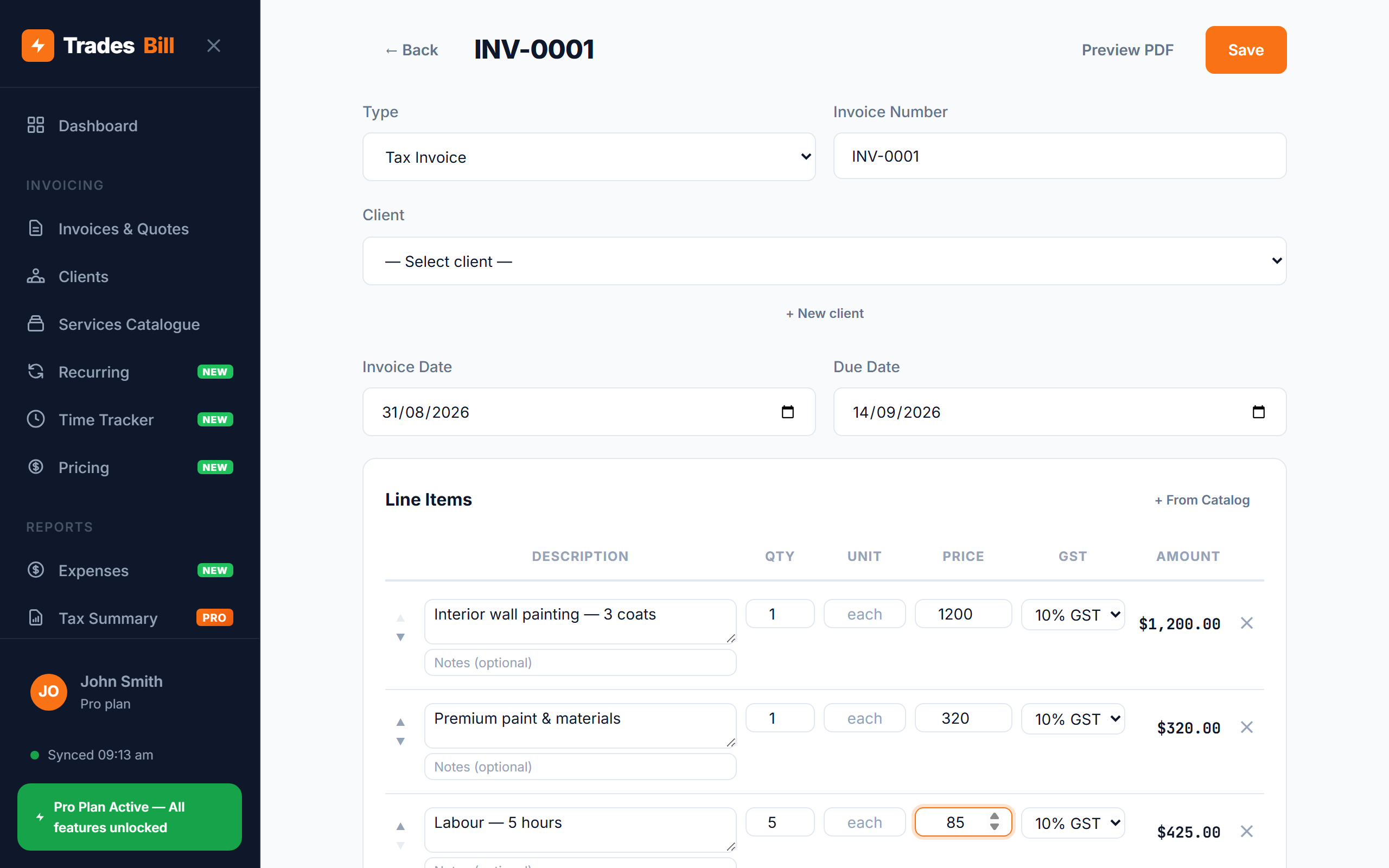
Learning how to invoice as a painter in Australia comes down to getting a handful of things right every time: an ATO-compliant Tax Invoice, clear line items for paint and prep work, and a GST breakdown your customer can actually understand. Get the template right once and every job after that is just filling in the blanks.
This guide covers exactly what to include on a painting invoice, how to handle paint and materials costs, sample line items for the jobs you quote most often, and the mistakes that hold up payment.
How to invoice as a painter — what every invoice needs
If you're GST-registered (compulsory once your annual turnover reaches $75,000), every invoice you issue must be a valid Tax Invoice. At minimum, that means including:
- The words "Tax Invoice" — clearly labelled, not just "Invoice".
- Your business name — matching your ABN registration.
- Your ABN — your 11-digit Australian Business Number.
- Invoice date — the date you issue the invoice, not the date the job finished.
- A unique invoice number — sequential numbering keeps your job records straight, especially if you're running several jobs a week.
- Customer name and job address — required for invoices over $1,000, and worth including on every job so there's no confusion about which property the work was done at.
- Description of the work — itemised line items for surface prep, paint, and labour.
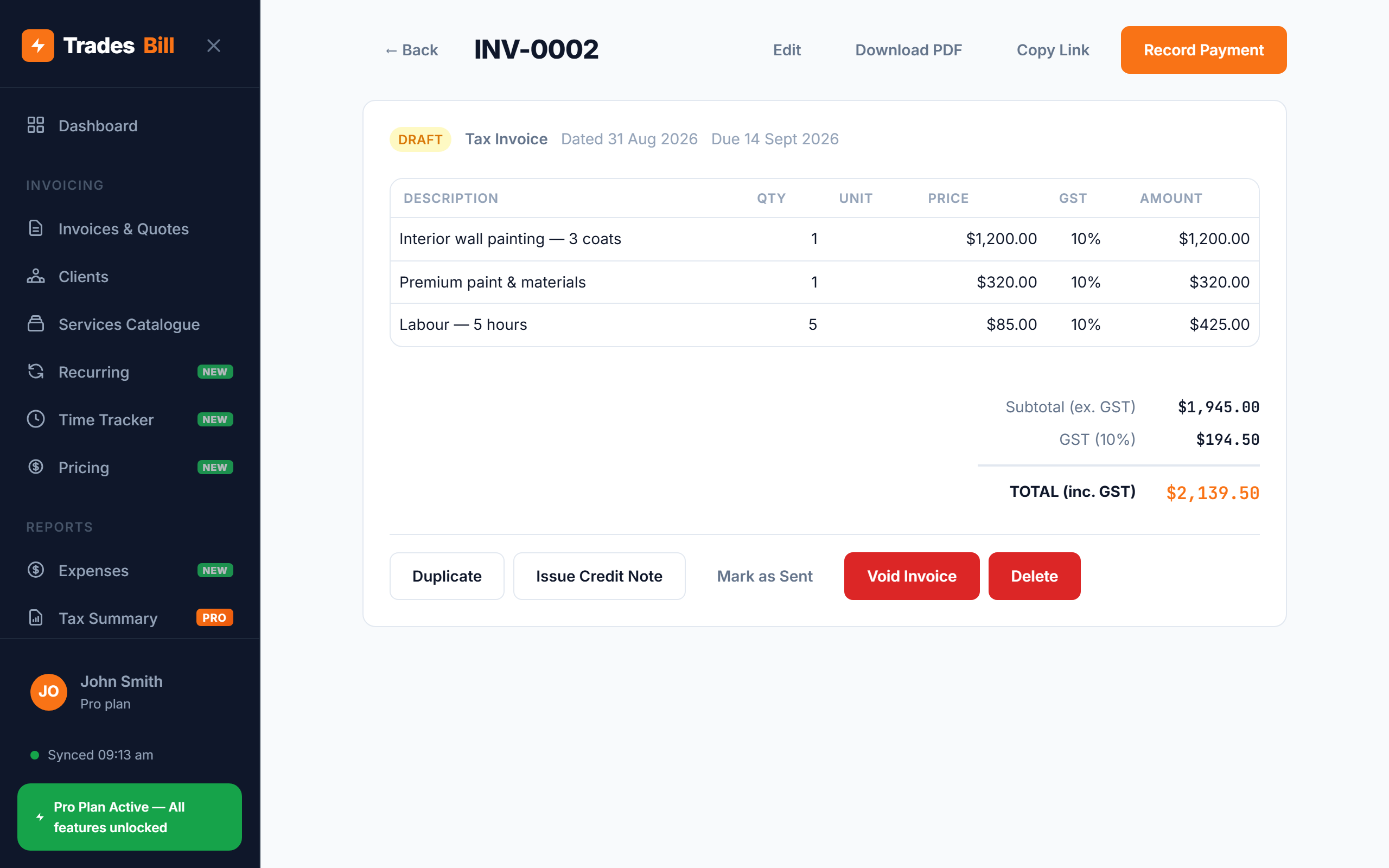
- GST amount — shown as a separate line, not folded into the total.
- Total amount due — including GST.
- Payment terms — when payment is due (e.g. on completion, or 7 days).
Tip: Painting jobs often run over a few days with the client popping in and out. Build your invoice as you go — recording line items per room or per day — rather than trying to remember every wall and coat count on the last afternoon.
Interior vs exterior vs commercial — how invoicing differs
Interior painting — repaints, feature walls, new-build handover coats — is usually priced per room or per square metre and invoiced directly to the homeowner once the job is complete, sometimes with a deposit for larger repaints.
Exterior painting — weatherboards, render, fascia and gutters — typically takes longer, involves more prep (scraping, sanding, priming bare timber) and more paint, so it's worth breaking prep and topcoats into separate line items so the client can see where the time went.
Commercial and new-build painting — working under a builder or head contractor — is usually invoiced against a purchase order or job number, often in progress claims for larger projects, the same way a builder invoices progress payments.
Paint and materials costs for painters
Most painters build the cost of paint, primer, filler, tape and drop sheets into their quoted price rather than itemising every tin. There's no fixed rule, but two things matter more than exactly how you price it:
- Disclose your paint brand and quality upfront. A client who expected a premium low-VOC paint and gets a budget trade tin will dispute the invoice — set expectations in the quote.
- Show materials as part of the line item price, not as a vague add-on. E.g. "Supply and apply 2 coats premium acrylic — living room, $18/m²" already includes paint and materials, rather than a separate unexplained "materials fee".
How to invoice for common painting jobs
Here are sample line items for jobs painters bill every week. Adjust pricing, coats and areas to suit your rates and the scope of the job.
Interior repaint (single room)
- Prep — filling, sanding, masking, drop sheets
- Supply and apply 2 coats [paint brand/type] to walls, [area] m²
- Supply and apply 1 coat ceiling paint, [area] m²
- Trim, skirting and door frames — [linear metres]
Exterior repaint
- Prep — high-pressure wash, scraping, sanding, spot priming bare timber
- Supply and apply 2 coats exterior [paint type] to weatherboards/render, [area] m²
- Fascia, gutters and eaves — [linear metres]
- Scaffold or elevated work platform hire (if applicable)
Feature wall or accent finish
- Prep and masking of adjoining surfaces
- Supply and apply [number] coats [colour/finish], [area] m²
- Specialty finish surcharge (e.g. Venetian plaster, textured, two-tone)
New-build handover coat (subcontract to a builder)
- Supply and apply handover coats per specification — as per purchase order [number]
- Labour — [hours] hours
- Reference to head contractor's job number
Deck or fence staining
- Prep — cleaning, sanding, masking
- Supply and apply [number] coats decking oil/stain, [area] m²
- Labour — [hours] hours at $[rate]/hr
How to handle GST on painting invoices
If you're registered for GST, you charge 10% on top of both labour and materials — including any paint and consumables built into your price. Your invoice must show the GST amount separately from the subtotal, followed by the total amount due.
If your turnover is under the GST registration threshold of $75,000 and you haven't voluntarily registered, don't add a GST amount at all — and don't use the words "Tax Invoice" on your invoices, since that label is reserved for GST-registered businesses.
Note: If you're subcontracting on a new build or commercial site, check whether your invoice needs to reference the builder's purchase order or job number before GST is applied — many builders won't process a payment claim without one, regardless of how correct the GST breakdown is.
Common invoicing mistakes painters make
- Not specifying the paint brand or number of coats — leads to disputes when the client expected a different finish or more coats than were quoted.
- Lumping prep and painting into one vague line — "Painting" tells the client nothing. Break out prep, coats and trim separately so they can see the work.
- Underquoting prep-heavy exterior jobs — scraping and priming bare timber takes real time; if it's not itemised, it's easy to undercharge for it.
- Skipping the purchase order or job number on subcontract invoices — a common reason head builders bounce claims back.
- Forgetting the GST breakdown — see our GST calculation guide for the two quick formulas.
- Using paper quotes and handwritten invoices on site — easy to lose in the ute, and slower to turn into a proper Tax Invoice at the end of the day.
Invoice like a professional painter — for free
TradesBill is a free invoice app for tradies. Add your ABN and bank details once — then create ATO-compliant Tax Invoices on site in under 60 seconds, room by room if you need to. Free forever, works offline.
Create your first invoice — FreeFrequently asked questions
Do I need a licence to invoice as a painter?
Requirements vary by state — some states require painters to hold a specific trade licence or be registered once work exceeds a certain value, others don't. Check with your state's building or fair trading authority for the rules that apply where you work.
Do I need an ABN to invoice as a painter?
Yes. To invoice as a business in Australia you need an ABN — without one, your customers are required to withhold 47% of the payment and send it to the ATO. Register for free through the Australian Business Register.
Should I quote per room, per square metre, or as a flat job price?
All three are common. Per-square-metre pricing is easiest to justify and adjust if the scope changes; a flat job price is simpler for the client to understand. Whichever you use for the quote, keep your invoice itemised so the client can see what they paid for.
Should I invoice a deposit before starting a painting job?
It's common practice for larger repaints, especially where you need to buy a significant amount of paint upfront. A deposit of 20–50% is typical, but always set this out in your quote before work begins.
What if the client wants extra coats after I've already quoted?
Treat it as a variation — confirm the extra cost with the client before applying the additional coat, then add it as its own line item on the invoice so the change is clearly documented.