"Net 14", "30 days EOM", "due on receipt" — invoice payment terms in Australia come in a few flavours, and the ones you put on your invoice have a real effect on how fast you get paid. Pick terms that are too loose and you're funding your customer's cash flow out of your own pocket. Leave them off entirely and you've got nothing to point to when a bill goes unpaid.
This guide explains what each common payment term means, which ones suit different kinds of tradie work, and how to word them so there's no confusion about when the money is due.
What are invoice payment terms?
Payment terms are the conditions you set for when and how a customer pays you. At minimum they tell the customer the due date. Good payment terms also cover how to pay (bank transfer, card, cash) and what happens if payment is late.
There's no single law in Australia that sets a standard payment period for small business invoices — for most jobs, it's up to you and your customer to agree. That's exactly why it matters to put your terms in writing: on your quote, and again on the invoice.
Agree terms before the job, not after. Payment terms carry the most weight when the customer has seen and accepted them before work starts — ideally on the quote. Adding strict terms for the first time on the final invoice is much harder to enforce.
Common invoice payment terms in Australia (and what they mean)
| Term | What it means | Good for |
|---|---|---|
| Due on receipt / COD | Pay immediately, or on completion of the job | Small domestic call-outs, one-off customers |
| Net 7 | Full amount due 7 days after the invoice date | Most residential jobs |
| Net 14 | Full amount due 14 days after the invoice date | Larger residential jobs, small businesses |
| Net 30 | Full amount due 30 days after the invoice date | Commercial clients, builders, property managers |
| 30 days EOM | Due 30 days after the end of the month the invoice was issued | Often requested by larger companies |
| Deposit + balance | Part paid upfront, remainder on completion | Jobs with big material costs |
Watch out for EOM terms — they stretch further than they sound. An invoice dated 2 March on "30 days EOM" isn't due until 30 April, nearly two months later. If a client asks for EOM terms, factor that wait into your cash flow.
Which payment terms should a tradie use?
Shorter is almost always better for sole traders. You've already paid for materials, fuel and your time — the sooner the invoice is paid, the less you're out of pocket. As a rule of thumb:
- Homeowners: Net 7 or due on completion. Most people are happy to pay within a week, and a short deadline keeps the invoice top of mind.
- Small businesses and landlords: Net 7 or Net 14.
- Commercial clients and builders: Often set their own terms (commonly 30 days or EOM). Negotiate before you start, and read their subcontract carefully.
- Big material outlays: Ask for a deposit upfront so you're not carrying the cost of supplies.
- Regular maintenance clients: Consistent terms every time — e.g. Net 14 on each monthly invoice.
Building and construction work: Each state and territory has security of payment legislation that can cap how long payment terms in construction contracts can be, and gives you a formal process to claim progress payments. The rules differ by state, so check your state's legislation or get advice before agreeing to long terms on a construction job.
How to write payment terms on an invoice
Vague terms like "please pay promptly" leave room for argument. Spell it out. Every invoice should show:
- The invoice date — the day you issued it.
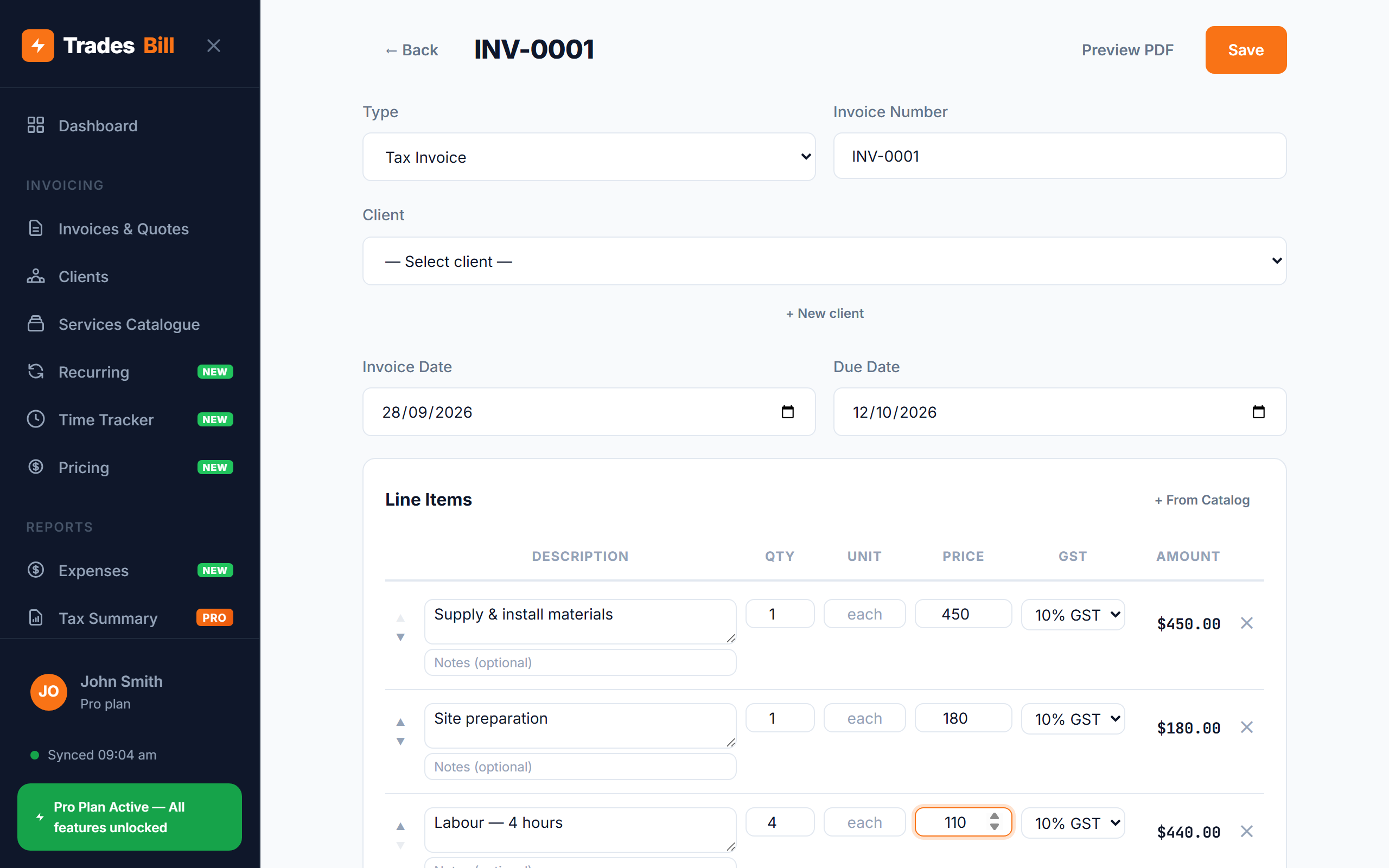
- A clear due date — an actual date, e.g. "Due: 12 October 2026", not just "Net 14".
- How to pay — your BSB and account number, a card payment link, or both.
- What reference to use — usually the invoice number, so you can match the payment.
- Any late payment terms — only if you agreed them with the customer upfront.
Here's simple wording you can adapt:
Payment terms: Payment is due within 7 days of the invoice date (by 5 October 2026). Please pay by bank transfer to BSB 000-000, Account 00000000, using invoice number INV-0042 as the reference.
Payment terms sit alongside the fields the ATO requires on a tax invoice — they don't replace them. If you're GST-registered, check you've also got every item on our tax invoice checklist.
What if a customer pays late?
Clear terms make chasing a late invoice much easier, because the due date isn't up for debate. A sensible approach:
- Send a friendly reminder a day or two before the due date.
- Follow up the day after it's overdue, then again at 7 and 14 days.
- Escalate with a formal final notice if it's still unpaid after that.
Our guide on how to follow up an unpaid invoice has copy-and-paste email templates for each stage. If you want to charge interest or a fee on overdue amounts, that needs to be in your agreed terms before the work starts — see how to charge a late payment fee.
A free invoice app for tradies takes most of the chasing off your plate: it works out the due date from your terms, and shows at a glance which invoices are paid, due, or overdue.
Set your payment terms once — every invoice follows them
TradesBill adds a clear due date and your payment details to every invoice, and flags overdue invoices automatically. Free forever, works offline.
Create your first invoice — FreeFrequently asked questions
What does "net 30" mean on an invoice?
Net 30 means the full invoice amount is due within 30 days of the invoice date. "Net" refers to the total amount owing, including GST.
Is there a legal maximum for invoice payment terms in Australia?
For most small business and domestic work, no — terms are whatever you and your customer agree. Construction work is the main exception, where state security of payment laws can limit payment periods. Some large businesses also report their payment times to the government under the Payment Times Reporting Scheme.
Should the due date be on the invoice?
Yes. It isn't one of the ATO's required tax invoice fields, but showing a specific due date is the single easiest way to reduce late payments.
Can I change my payment terms for an existing customer?
Yes, but give them notice and apply the new terms to future work, not to invoices already sent. Put the new terms on your next quote so they're agreed before the job starts.
TradesBill is not a registered tax agent or legal adviser. This article is general information only — get professional advice for your specific situation.