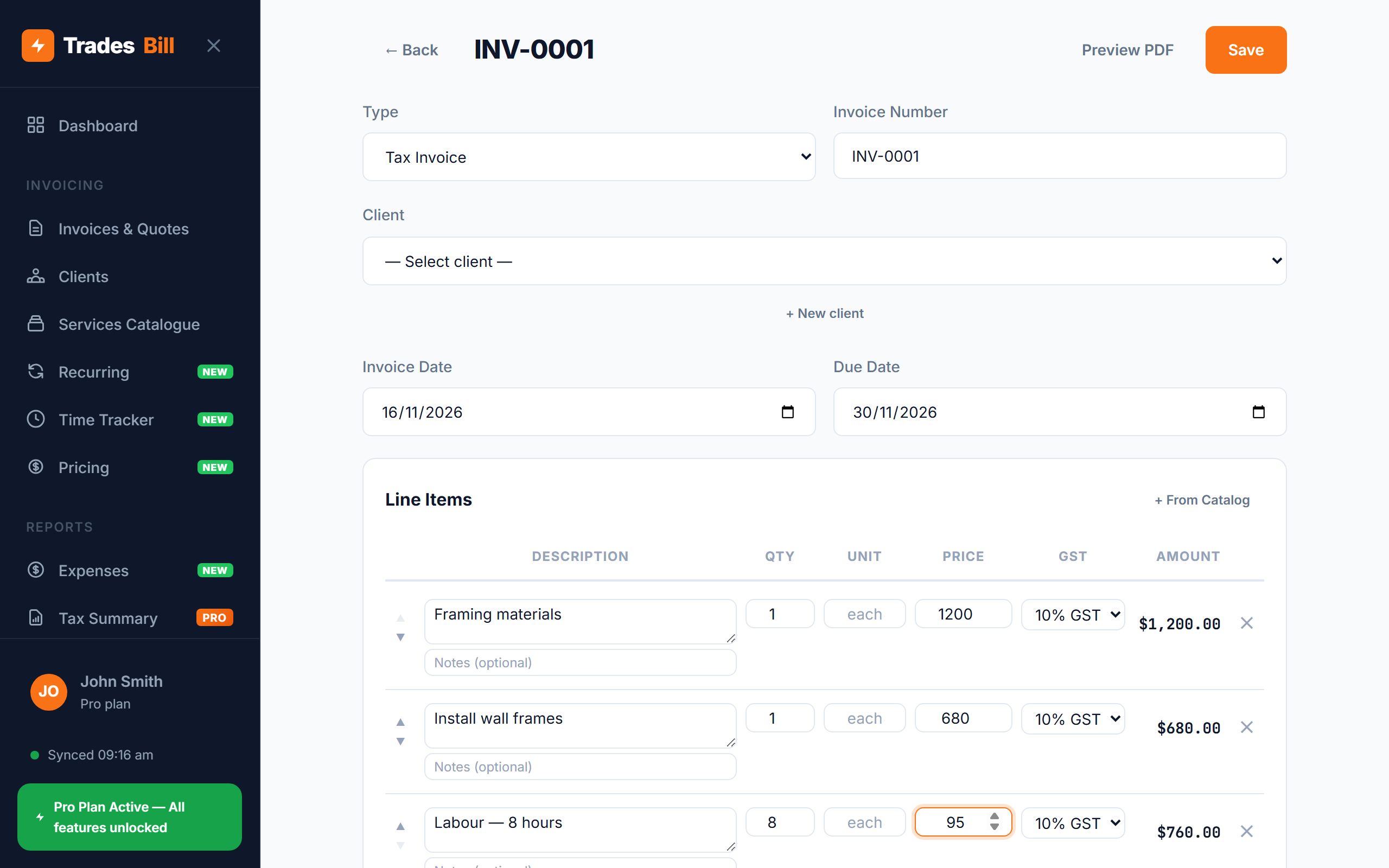
Working under a head contractor or builder is a great way to keep busy, but it comes with its own paperwork. If you're wondering how to invoice as a subcontractor in Australia, the short answer is: you invoice the person who engaged you (not the homeowner), you quote your ABN, and you add GST if you're registered. The subcontractor invoice requirements in Australia are the same ATO rules that apply to any business, plus a few things specific to working under someone else.
This guide walks through what to put on the invoice, how GST and ABN withholding work, and how to get paid on time by a head contractor.
Who do you invoice as a subcontractor?
You invoice whoever hired you — usually the head contractor, builder or project manager — not the end client. Your contract (or the purchase order or work order they gave you) is with them, so they're the ones who owe you payment.
Before you start, confirm in writing:
- The exact business name and ABN to invoice. Head contractors often operate through a company or trust, which may differ from the name on the site signage.
- Any job or purchase order number they want quoted. Many larger firms won't process an invoice without one.
- Who to send it to — often an accounts email address, not the site supervisor.
- Their payment cycle — for example a monthly claim cut-off date.
Subcontractor invoice requirements in Australia
If you're registered for GST, your invoice needs to be a valid tax invoice so your head contractor can claim their GST credit. The full list is in our guide to what must a tax invoice include, but in summary:
- The words "Tax Invoice" at the top
- Your business name and ABN (add "trading as" if you use a trade name)
- The date of issue
- A description of the work — what was done and where
- The GST amount shown separately, or a statement that the total includes GST
- The total amount payable
- The buyer's name and ABN — required for invoices of $1,000 or more, and it's good practice on every subcontractor invoice
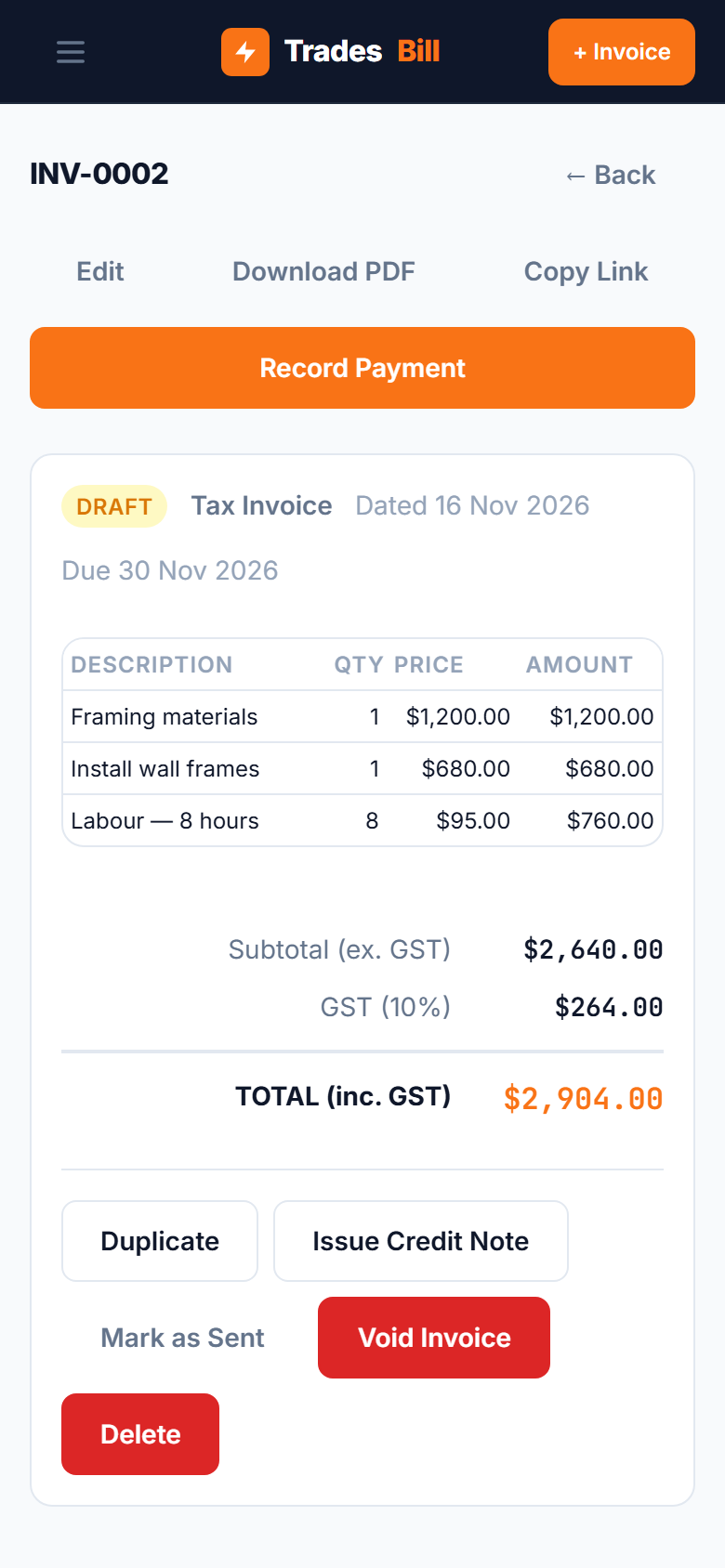
Not registered for GST? Then you don't charge GST, and your invoice isn't a "tax invoice". Just label it "Invoice", include your ABN, and leave GST off completely. Our guide on invoicing without an ABN explains why the ABN part matters so much.
Add the extras head contractors ask for
Beyond the ATO basics, subcontractor invoices usually need a few site-specific details so accounts can match them to a job:
- Job name or site address
- Purchase order or job number
- Reference to the quote or variation the work relates to
- Claim number if you're billing in stages (e.g. "Progress claim 2 of 4")
- Your bank details and payment terms
Sample subcontractor invoice line items
| Description | Amount (ex GST) |
|---|---|
| PO 4471 — Framing labour, Lot 12 (progress claim 2) | $3,200.00 |
| Variation 3 — extra bracing to south wall | $450.00 |
| GST (10%) | $365.00 |
| Total payable | $4,015.00 |
Keep variations as separate lines that reference the approved variation, so the head contractor can pass them up the chain without questions. For staged jobs, see how to invoice for a deposit or progress payment.
ABN withholding: why your ABN matters
If you don't give your ABN to the business paying you, they may be required to withhold tax from the payment at the top marginal rate (currently 47%, including the Medicare levy) and send it to the ATO. You can claim that amount back in your tax return, but your cash flow takes a hit in the meantime. The simple fix: always put your ABN on every invoice, and quote it before you start work.
Are you really a subcontractor? Contractor vs employee
Having an ABN doesn't automatically make you a subcontractor. The ATO looks at the actual working relationship — who controls how the work is done, whether you supply your own tools and materials, whether you can delegate the work, and whether you carry the risk of the job. In some cases, a contractor who is paid mainly for their labour may be treated as an employee for superannuation purposes, which is a head-contractor obligation but affects how your contract should be written. If you're unsure where you stand, ask the ATO or a registered tax agent.
Payment terms and getting paid on time
Head contractors often pay on a monthly claim cycle, so agree terms before the job starts and put them on every invoice. Common options are 7, 14 or 30 days — our guide to invoice payment terms explains which suits which job. A few practical habits help:
- Invoice promptly — send it as soon as the work or milestone is signed off, and before the head contractor's claim cut-off.
- Keep records of variations, instructions and sign-offs in writing.
- Follow up early if an invoice goes unpaid — see how to follow up an unpaid invoice.
In the building and construction industry, each state and territory has its own security of payment laws with specific rules about payment claims and deadlines. If you're doing construction work, check the rules for your state, because a claim that doesn't meet the requirements can lose you important rights.
Keep your subcontractor invoices organised
Subcontractors often juggle several head contractors at once. A free invoice app for tradies like TradesBill keeps your ABN, GST and invoice numbering consistent, lets you save each head contractor as a client, and shows at a glance which invoices are unpaid. That makes your BAS much easier too — see how to do your BAS as a sole trader.
Send subcontractor invoices in minutes
Add your ABN once, save your head contractors as clients, and TradesBill adds the GST and every required field automatically. Free forever, works offline.
Create your first invoice — FreeFrequently asked questions
Do subcontractors have to charge GST?
Only if you're registered for GST. Registration is required once your annual turnover reaches $75,000 and optional below that. See our guide to the GST registration threshold.
Can I invoice a head contractor without an ABN?
You can, but they'll generally have to withhold tax from your payment. It's far better to get an ABN, which is free to apply for at the Australian Business Register.
Should I invoice the homeowner or the builder?
Whoever engaged you. If the builder hired you, invoice the builder.
How do I calculate GST on a subcontractor invoice?
Add 10% to your price, or divide a GST-inclusive total by 11 to find the GST. Our guide on how to calculate GST on an invoice has worked examples.
Disclaimer: TradesBill is not a registered tax agent. This article is general information only. For advice on your GST, ABN withholding, contractor status or payment rights, speak to a registered tax agent, BAS agent or a legal adviser.